B2B Marketing Strategies That Drive Real Growth in 2026
09/11/2026
Marketing Strategy
11 B2B marketing strategies for 2026 — SEO, LinkedIn, ABM, email, content, and CRM tactics tied to pipeline velocity, not vanity metrics.

The most effective marketing strategies for B2B in 2026 share one trait: they tie every tactic directly to pipeline velocity and measurable revenue, not vanity metrics. Generic brand awareness campaigns and scattered content calendars no longer move the needle for sophisticated buyers. What works is a coordinated system where SEO, content, paid media, CRM, and brand authority reinforce each other at every stage of the buying cycle.
.png)


Overview, Plus Email Marketing, SEO, and LinkedIn Tactics That Drive B2B Growth



Here are the core strategies driving B2B growth right now:
- Account-Based Marketing (ABM): Target high-value accounts with personalized, coordinated outreach across channels
- Entity-authority SEO: Build pillar pages and topic clusters that position your firm as the definitive source on your niche
- LinkedIn marketing: Combine thought leadership content with precision-targeted ads and ABM retargeting
- Personalized email sequences: Segment by buyer stage and persona, then automate nurturing workflows
- B2B content marketing: Publish original research, benchmark studies, and case studies that earn backlinks and trust
- Video marketing: Use demos, explainers, and client testimonials to educate buyers across the funnel
- CRM-driven alignment: Centralize lead data to keep sales and marketing working from the same playbook
- Webinars and virtual events: Generate qualified pipeline while demonstrating expertise in real time
- Trade shows and industry events: Compress trust cycles and create conversations that digital channels rarely replicate
- Referral and partner marketing: Build a managed referral system that turns relationships into repeatable revenue
- B2B branding strategy: Align brand positioning with performance marketing to create demand, not just awareness
Each of these tactics works harder when it connects to a performance-driven framework that reports on Marketing Qualified Pipeline and cost per MQL rather than raw lead counts.
1. How to make email marketing work for B2B engagement
Email remains one of the highest-ROI channels in B2B, but only when it moves beyond batch-and-blast. The difference between email that nurtures and email that gets ignored comes down to segmentation and timing. Targeted emails matched to buyer personas and funnel stage consistently outperform generic broadcasts in both open rates and pipeline contribution.
Practical tactics that separate high-performing B2B email programs:
- Segment by firmographic and behavioral data: Industry, company size, job title, and recent content engagement all signal where a prospect sits in the buying cycle
- Map sequences to buyer stages: Awareness-stage contacts need education; evaluation-stage contacts need proof, case studies, and pricing clarity
- Automate trigger-based workflows: A prospect who downloads a benchmark report should receive a follow-up sequence tied to that specific topic, not a generic newsletter
- Personalize beyond the first name: Reference the prospect's industry, a recent event in their sector, or a specific pain point your firm solves
- Track the metrics that matter: Open rate is a vanity metric. Focus on click-to-conversion rate, meetings booked, and pipeline influenced per campaign
Pro Tip: Set up a "re-engagement" sequence for contacts who have gone cold after 60 days. A short, direct email asking whether their priorities have changed often reactivates more pipeline than any promotional offer.
2. Modern SEO approaches for B2B success in 2026
B2B SEO in 2026 is no longer about keyword density. AI search engines now favor websites that act as a definitive source of truth for specific complex topics, which means entity authority has replaced keyword stuffing as the primary ranking signal. For B2B firms, this shift is an opportunity: if you build genuine depth around your niche, you become the site that both Google and AI-powered search tools surface first.
The architecture that makes this work is the pillar-and-cluster model. A pillar page covers a broad topic at depth (think 3,000-plus words on a category your firm owns), while a set of cluster articles answer specific sub-questions and link back to the pillar with descriptive anchor text. This structure signals topical authority to search engines and keeps buyers on your site longer.
Key execution points for B2B SEO in 2026:
- Target investigative and commercial intent keywords: Shift from "what is X" queries to "cost of outsourcing X vs. in-house" and "how to navigate [regulation] for [industry]" searches that capture buyers in evaluation mode
- Deploy Schema.org markup: Use Person schema to link authors to their LinkedIn profiles and published work, FAQ schema to win featured snippets, and Review schema to display star ratings in search results
- Build trust signals for YMYL sectors: If your firm operates in finance, legal, or healthcare-adjacent services, author transparency and structured data are table stakes, not optional extras
- Optimize landing pages for specific verticals: Industry-specific pages must address the unique terminology and pain points of each sector rather than mirroring each other with swapped logos
Statistic callout: AI search engines in 2026 prioritize sites that demonstrate comprehensive, expert-level coverage of niche topics over sites that simply repeat popular keywords.
3. Effective LinkedIn marketing tactics for B2B growth
LinkedIn is the only social platform where B2B buyers actively expect to encounter professional content, which makes it uniquely valuable for both organic reach and paid targeting. The mistake most B2B marketers make is treating it as a broadcast channel. The firms that generate real pipeline use LinkedIn as a layered system: organic thought leadership builds familiarity, while paid campaigns and ABM retargeting convert that familiarity into meetings.
LinkedIn Ads combined with ABM retargeting workflows significantly improve high-value lead generation for B2B firms. The targeting precision available on LinkedIn, including job title, seniority, company size, and even specific company lists, makes it the most direct path to decision-makers in most B2B categories.
Tactics worth building into your LinkedIn program:
- Publish point-of-view content, not just company updates: Posts that take a clear position on an industry trend or challenge generate far more engagement than announcements
- Use LinkedIn Ads with layered audience targeting: Combine job function, seniority, and company size filters to reach the exact buyer profile you defined in your ideal client profile
- Run ABM retargeting sequences: If a prospect clicked a LinkedIn ad, follow up with a Google Display ad featuring a client result or case study to maintain presence across channels
- Engage in niche groups and comment threads: Consistent, substantive comments on posts by your target buyers build visibility without ad spend
- Test competitor-adjacent keywords: Bidding on terms that buyers use when evaluating alternatives captures prospects already in active consideration mode
Free Brand Health Audit
Make sure your brand is built to sell
Search has changed. Your customers aren't just Googling anymore. They're asking ChatGPT, Perplexity, Gemini and other AI platforms what to buy, who to trust and which brands they should consider.
If your brand isn't showing up clearly in those answers, you're already losing opportunities. Our free Brand Health Audit shows you where your brand stands across traditional search, AI search and brand positioning.

Sample brand audit
Live preview
Traditional search
72
AI search (GEO)
34
Brand positioning
58
Video, CRM Alignment, and Content Marketing Strategies for B2B



4. Why video marketing belongs in every B2B strategy
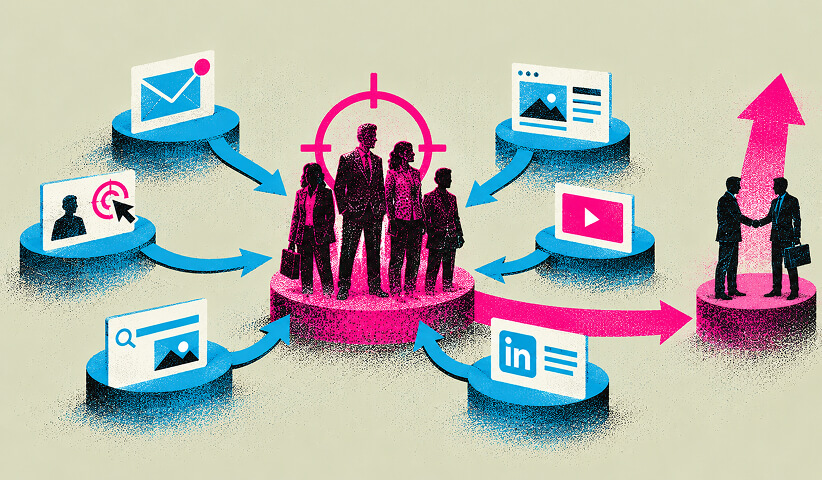
Video is the format B2B buyers actually consume when they are evaluating a purchase. A written case study tells a story; a video case study with a real client speaking to camera makes it credible in a way text rarely achieves. Demos, explainers, and testimonial videos each serve a distinct purpose in the funnel, and the firms that map video content to buyer stage get measurably better results from the format.
Interactive tools take this further. A compliance calculator or ROI projector generates three times more high-intent leads than a static PDF whitepaper because it delivers immediate, personalized value. Video and interactive content share the same underlying logic: they give buyers something useful before asking for anything in return.
How to build a B2B video program that actually converts:
- Match video type to funnel stage: Explainers work at awareness, demos work at consideration, and client testimonials close the gap at decision
- Distribute across multiple channels: Host on YouTube for search discoverability, embed on landing pages for conversion, and cut short clips for LinkedIn and email campaigns
- Measure engagement depth, not just views: Watch-through rate and click-to-next-step conversion matter more than raw view counts
- Repurpose efficiently: One 20-minute webinar recording can yield five short LinkedIn clips, a blog post, and a nurture email, all from a single production effort
5. How CRM platforms strengthen B2B marketing and sales alignment
A CRM platform is the connective tissue between marketing activity and sales outcomes. Without centralized lead data, marketing teams optimize for metrics that sales teams never see, and sales teams work leads without context from prior marketing touchpoints. The result is wasted budget and a buyer experience that feels disjointed.
Using CRM data from closed-won clients to build lookalike audiences on Meta and LinkedIn is one of the highest-leverage moves available in B2B paid media. Your best clients tell you exactly who to target next. CRM platforms like Salesforce and HubSpot make this loop practical by connecting ad platform integrations directly to deal data.
What a well-configured CRM enables for B2B marketing:
- Centralized buyer journey tracking: Every touchpoint from first content download to signed contract lives in one place, making attribution accurate
- Automated segmentation and nurturing: Contacts move between sequences automatically based on behavior, not manual tagging
- Sales and marketing handoff clarity: Defined lead scoring criteria mean sales teams receive contacts at the right moment, not too early or too late
- Upsell and retention triggers: CRM data surfaces signals that a current client is ready for an expanded engagement before the account manager notices
6. Content marketing strategies tailored for B2B companies
The best B2B content does one thing that generic content cannot: it acts as a salesperson that never sleeps. Original research, benchmark studies, and deep-dive case studies generate qualified inbound interest long after publication, and they earn the kind of backlinks that accelerate SEO authority in ways that paid links never can.
The key shift for 2026 is moving from summarizing industry news to producing proprietary data. If your firm has anonymized client data, aggregate it into a benchmark report. If you work in a regulated sector, build a maturity model where prospects can score themselves against industry standards. That self-assessment gives you qualifying data before the first sales call.
Content formats that consistently perform in B2B:
- Original research and benchmark studies: The only content type that reliably earns high-quality backlinks from authoritative domains
- Deep-dive case studies: Not victory laps, but decision aids that walk a prospect through the problem, the process, and the measurable result
- Repurposed content atoms: One industry report becomes ten LinkedIn posts, five short videos, and a retargeting ad sequence, keeping your firm visible across a six-month sales cycle
- Buyer-stage alignment: Awareness content answers broad questions; consideration content explains your process; decision content handles objections and scope clarity
Pro Tip: Turn every sales call objection into a content prompt. If prospects repeatedly ask about implementation timelines or pricing models, those questions are your editorial calendar.
For B2B manufacturing firms specifically, content strategies that establish industry authority require a different angle than professional services content, with more emphasis on technical depth and supply chain specifics.
Want your B2B tactics working as one system instead of eleven? Keep reading!
If you need brand, content, paid media, and retention connected to pipeline, contact us for a free custom quote.
Account-Based Marketing Essentials and B2B Branding Strategy Best Practices
7. Account-Based Marketing essentials for targeted B2B campaigns
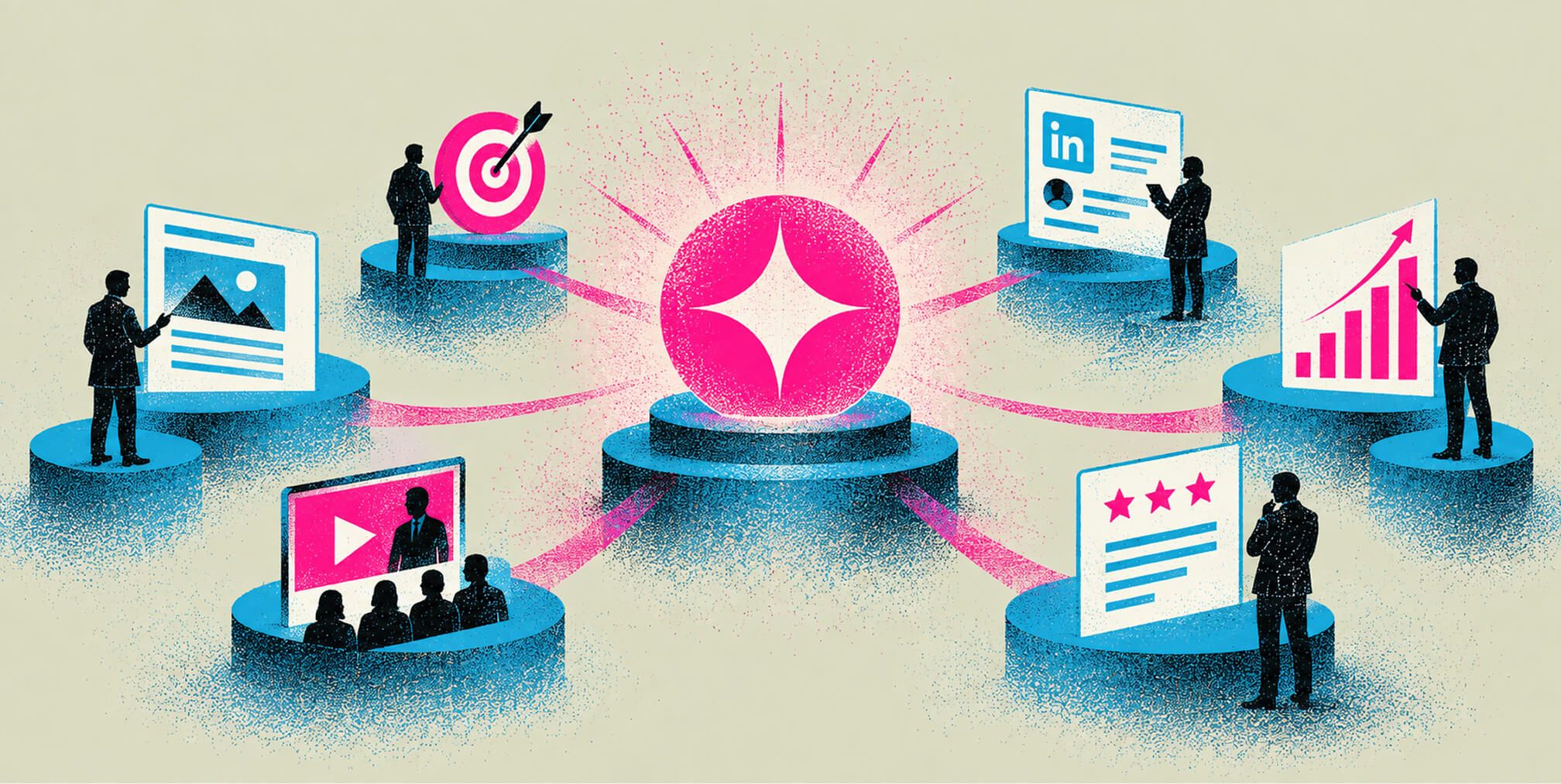
ABM flips the traditional funnel. Instead of generating broad awareness and hoping the right buyers find you, ABM starts with a defined list of high-value target accounts and builds coordinated marketing and sales activity around each one. The result is a tighter pipeline with higher average deal values and shorter sales cycles.
Firmographic and technographic targeting are the foundation of effective ABM. Firmographics tell you which companies fit your ideal client profile by size, industry, and revenue. Technographics tell you which tools they already use, which reveals budget, sophistication level, and potential integration needs. Together, they let you build a target account list that sales and marketing can align around from day one.
ABM execution essentials:
- Build a target account list collaboratively: Sales and marketing must agree on the criteria before any campaign launches
- Coordinate messaging across channels: A prospect should encounter consistent, personalized messaging whether they see a LinkedIn ad, receive an email, or visit your website
- Use position-based attribution: Give credit to both the first touch that created awareness and the last touch that drove conversion, so you understand the full account journey
- Measure pipeline velocity, not just engagement: The goal is to accelerate how quickly target accounts move from awareness to proposal, not to accumulate impressions
8. B2B branding strategy insights and best practices for 2026
Strong branding is not separate from performance marketing in B2B. It is the multiplier that makes every other tactic work harder. A firm with clear category positioning, credible proof points, and consistent visual identity converts paid traffic at higher rates, earns more organic referrals, and commands better pricing than a firm competing on features alone.
The commodity trap is the most common branding failure in B2B. Moving from "we provide marketing services" to "we are the architects of brand-backed performance for growth-stage companies" is not just a messaging exercise. It changes how prospects perceive your pricing, your expertise, and your fit for their specific situation. The Branded Agency builds this kind of category leadership by aligning brand development with measurable marketing outcomes, so every creative decision connects back to pipeline and revenue.
Branding priorities that move the needle in 2026:
- Deploy E-E-A-T assets: Author bios with Schema markup, published research, speaking credentials, and real client results all signal expertise to both search engines and buyers
- Use data-backed messaging: Replace "we are experts" with specific, verifiable proof points tied to client outcomes
- Align brand and performance budgets: A 60/40 split favoring high-intent search and ABM is a proven starting point for growth-stage B2B firms
- Treat your B2B brand strategy as a living asset: Positioning should be reviewed annually against competitive shifts and buyer language changes
The 7 Ps marketing framework (product, price, place, promotion, people, process, and physical evidence) provides a useful audit structure for B2B branding. Running your positioning through each dimension reveals gaps between how you describe your firm and how buyers actually experience it.
Trade Shows, Referrals, Webinars, Key Takeaways, and Building One System

9. How trade shows and industry events drive B2B pipeline
Trade shows and in-person industry events do something digital channels struggle to replicate: they compress the trust cycle. A 20-minute conversation at a niche conference can accomplish what six months of email nurturing cannot, because buyers read body language, ask unscripted questions, and make rapid credibility assessments in person.
The mistake most B2B firms make at events is attending without a follow-up system. Collecting business cards and sending a generic "great to meet you" email wastes the relationship capital built in the room. The firms that generate real ROI from events treat every conversation as the first step in a defined follow-up sequence, with personalized outreach tied to the specific topics discussed.
What makes event marketing work in B2B:
- Choose events where your buyers, not your peers, attend: Speaking at an industry conference your clients attend beats exhibiting at a marketing conference every time
- Prepare a specific conversation starter: A relevant insight, a recent piece of research, or a pointed question about a challenge your firm solves gives you a reason to engage beyond pleasantries
- Build a post-event sequence before you arrive: Know exactly what you will send, when, and to whom, so follow-up happens within 48 hours while the conversation is still fresh
- Track event-sourced pipeline separately: This lets you measure true ROI per event and decide which ones to prioritize next year
10. Referral and partner marketing strategies that build repeatable revenue
Referrals close faster and at higher rates than almost any other B2B lead source because trust transfers from the referrer to your firm before the first conversation. The problem is that most B2B companies treat referrals as something that happens to them rather than a system they manage. That passivity leaves significant revenue on the table.
A managed referral program starts with identifying your best referrers: former clients, complementary service providers, and peers who work with the same buyer profile. The next step is giving them language. Most referrers want to send you business but do not know how to describe what you do in a way that resonates with their contacts. A one-page description of your ideal client profile and the specific trigger situations that make your firm the right fit solves this immediately.
Building a referral system that compounds over time:
- Define trigger situations explicitly: "When a client is preparing for a Series B and needs to establish brand credibility before investor meetings" is more useful to a referrer than "we do B2B branding"
- Stay visible between referrals: Share relevant insights, useful content, and updates on the kinds of problems you are solving, so referrers think of you when the moment arises
- Close the loop every time: Thank referrers, update them on outcomes where appropriate, and make it easy for them to refer again
- Build partner relationships with complementary providers: A marketing firm partnering with a sales consulting firm, a CRM implementation partner, or a PR agency creates a mutual referral network where all parties benefit
11. Webinars and virtual event marketing for B2B lead generation
Webinars occupy a unique position in B2B digital marketing: they generate qualified pipeline while simultaneously demonstrating expertise in real time. A prospect who attends a 45-minute webinar on a topic directly relevant to their business has self-selected as a high-intent lead. They have invested time, engaged with your thinking, and given you permission to follow up with context.
The format also produces content that compounds. A single webinar recording yields short video clips for LinkedIn, a long-form blog post, a nurture email sequence, and a retargeting ad creative, all from one production session. For B2B firms with limited content budgets, webinars offer one of the best returns on content investment available.
Making webinars work as a pipeline channel:
- Choose topics that answer decision-stage questions: "How to evaluate [service category] vendors" outperforms "introduction to [topic]" because it attracts buyers already in consideration mode
- Promote to your target account list, not just your existing audience: Use LinkedIn Ads and email outreach to reach prospects who have never heard of your firm
- Build a post-webinar sequence that references specific content: Follow up with clips from the session tied to the exact questions attendees asked, not a generic recording link
- Track attendance-to-meeting conversion rate: This tells you whether your webinar content is attracting the right audience and whether your follow-up is converting interest into conversations
For a broader view of how digital marketing strategies connect across channels, the principles that make webinars effective apply to most B2B content distribution decisions.
Work with a team that builds B2B marketing systems, not just campaigns
The strategies in this guide work best when they connect to each other inside a single, coherent system. Isolated tactics produce isolated results. What growth-stage B2B companies actually need is a framework where brand, content, paid media, and retention reinforce each other at every stage of the buyer journey.
The Branded Agency builds exactly that. Our brand-backed performance approach aligns brand development with measurable marketing outcomes, so every creative decision connects back to pipeline and revenue. Whether you are building category authority from scratch, scaling a paid media program, or fixing a B2B website that generates traffic but not leads, we bring the strategy, creative, and execution to make it work.
Ready to build a B2B marketing system that compounds? Talk to our team and let's map out what growth looks like for your firm.
Key Takeaways
The most effective B2B marketing in 2026 ties every tactic directly to pipeline velocity and measurable revenue, not vanity metrics like raw lead counts or impressions.
| Point | Details |
|---|---|
| Pipeline over vanity metrics | Report on Marketing Qualified Pipeline and cost per MQL to maintain a clear line between marketing spend and revenue. |
| Entity authority drives B2B SEO | Build pillar pages and topic clusters to become the definitive source on your niche, which is what AI search engines now reward. |
| ABM requires sales and marketing alignment | Target account lists must be agreed on by both teams before any campaign launches, with coordinated messaging across all channels. |
| Referrals need a managed system | Give referrers explicit language and trigger situations; passive referral programs leave significant revenue uncaptured. |
| Brand and performance must connect | A 60/40 budget split favoring high-intent search and ABM is a proven starting point for growth-stage B2B firms. |
Recommended

Quincy Samycia
As entrepreneurs, they’ve built and scaled their own ventures from zero to millions. They’ve been in the trenches, navigating the chaos of high-growth phases, making the hard calls, and learning firsthand what actually moves the needle. That’s what makes us different—we don’t just “consult,” we know what it takes because we’ve done it ourselves.
Want to learn more about brand platform?
If you need help with your companies brand strategy and identity, contact us for a free custom quote.
We do great work. And get great results.
+2.3xIncrease in revenue YoY
+126%Increase in repurchase rate YoY



+93%Revenue growth in first 90 days
+144% Increase in attributed revenue




+91%Increase in conversion rate
+46%Increase in AOV




+200%Increase in conversion rate
+688%Increase in attributed revenue