Creative Operations Workflow: A Stage-by-Stage Guide for Growth Teams
11/16/2026
Design
Turn scattered creative requests into an efficient production system with eight clear stages that protect brand consistency, shorten approvals and improve output.
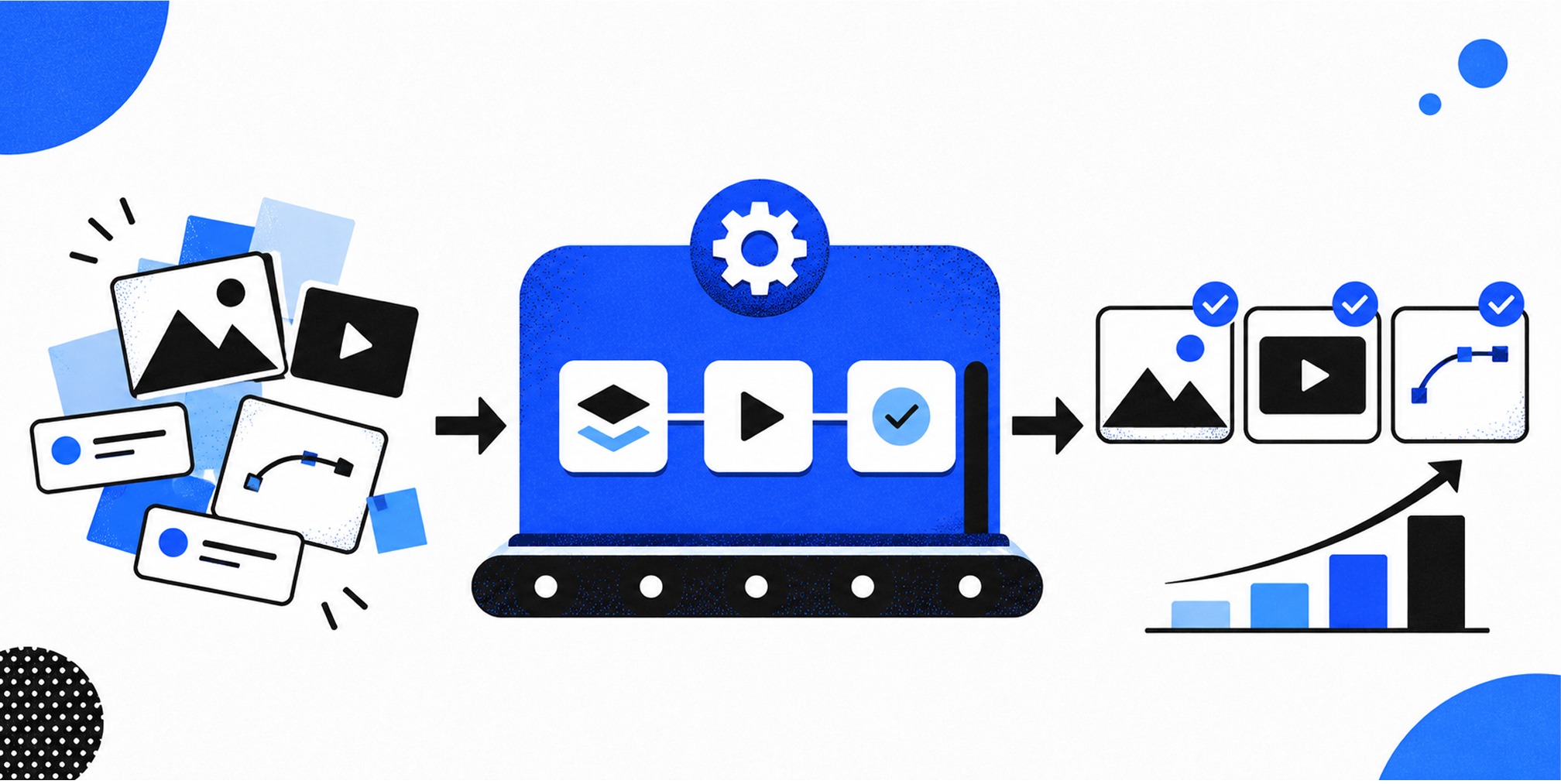
A creative operations workflow is the repeatable path every piece of creative work follows, from request to approved, shipped and measured asset, with an owner and a rule at each stage. Growth-stage teams get the most from it when it is tied to brand and performance goals from the first brief. Creative output then stays consistent as volume grows, and results trace back to the work that produced them. This guide walks through the stages, the roles, the approval design and the metrics, so a CEO, CMO or marketing director can see where their own process loses time.


What a creative operations workflow is, and what it is not
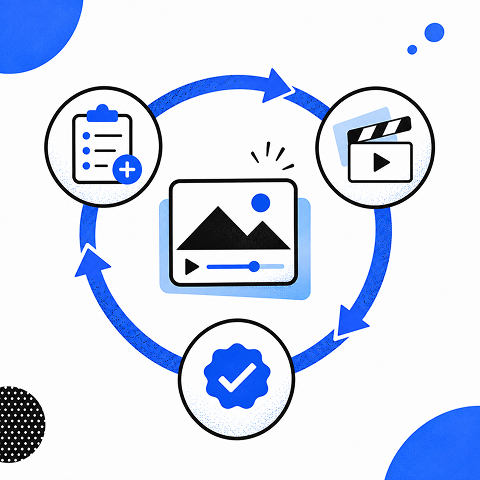

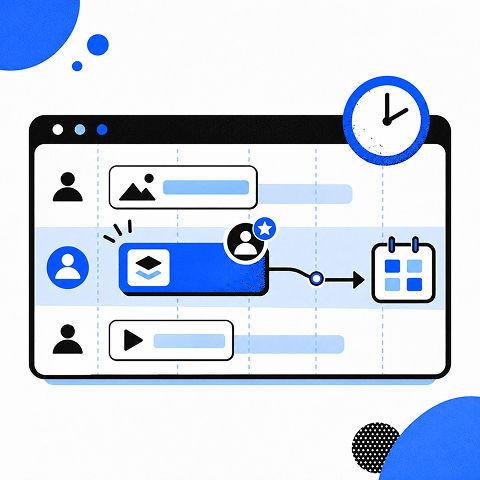
Creative operations, often shortened to creative ops, is a set of disciplines that aligns people, workflows and tools so creative teams can move quickly while keeping consistency and brand integrity. The workflow is the working core of that system.
A workflow defines the stages every project passes through: brief, scheduling, production, review, approval and delivery. It also defines who owns each stage and what must be true before work moves on.
The difference from project management matters for leaders deciding where to invest. Creative operations governs the whole system, meaning intake, review cadence and the feedback loop. Project management focuses on delivering one project on time and within scope. If you hire only for project management, every project may land on time while the system still leaks hours between projects.
A complete workflow answers four questions:
- Intake: What information is required before a request can enter production?
- Ownership: Who does the work, who gives feedback, and who has final approval?
- Progression: What is the exit criterion for moving from brief to production, review and delivery?
- Measurement: What happens after delivery, and how do results improve the next brief?
Those four areas are the typical scope of a creative workflow. If any one is vague, the workflow is a suggestion, not a system.
The creative production workflow, stage by stage
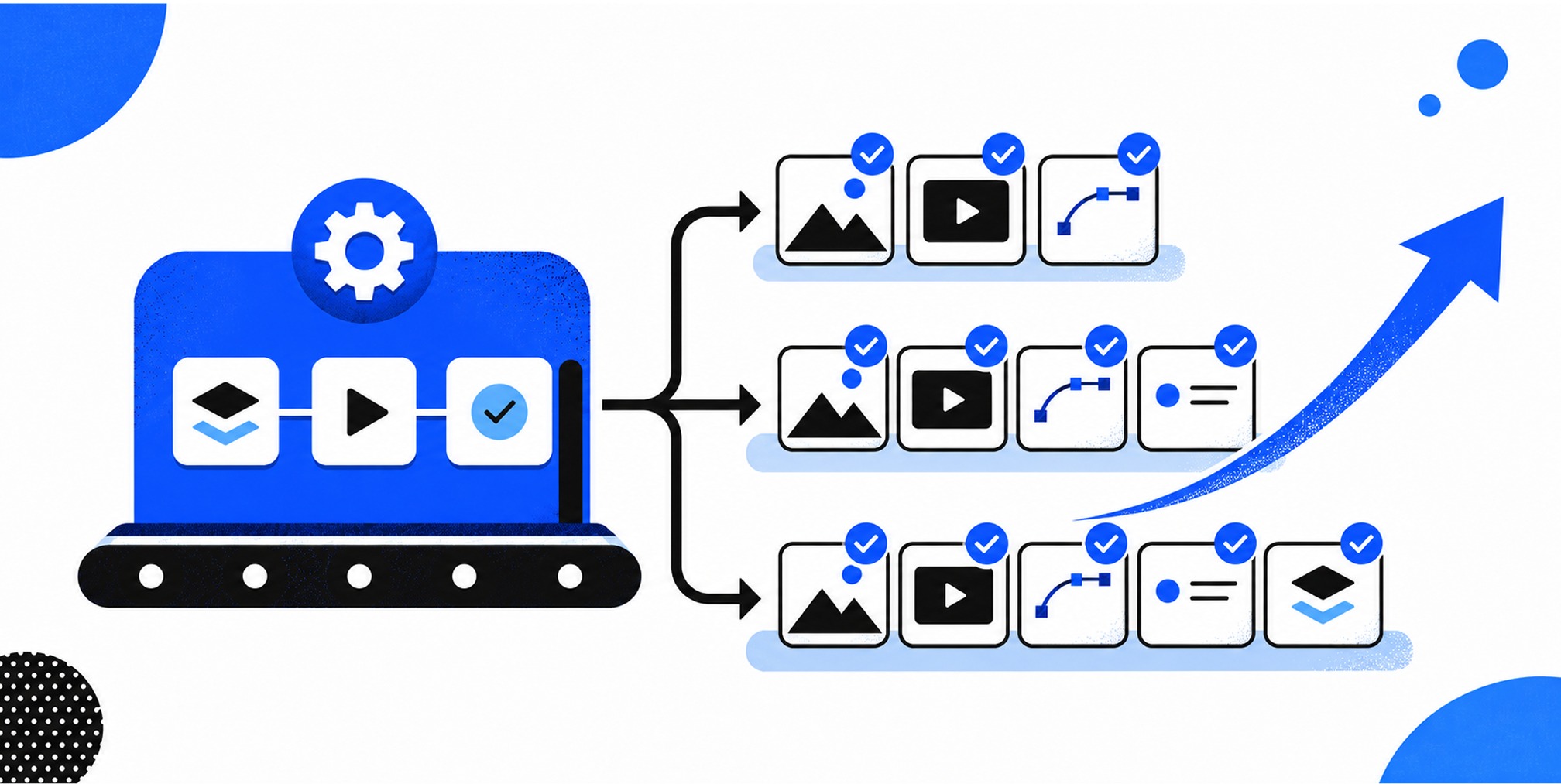
A production workflow moves from intake and brief, through triage, scheduling and role assignment, production, review, approval and delivery, then archive, reuse and debrief. Here is what each stage needs and where it usually breaks.
1. Intake: one door for every request
Every request enters through one channel with the same required fields. Without that, requests arrive by chat, email and hallway, and the team spends its first hours reconstructing what was wanted.
Require the business goal, the audience, the channel, the deadline and the approver at submission. Intake also protects strategy: when each request is checked against company priorities and brand standards at the door, the team stops producing work that no one can justify later.
2. The creative brief: the contract for the work
The brief is where most downstream revision rounds are born. A good brief states the offer, the audience and the channels, so drafts can be built against brand guidelines instead of guesses. If you need a model, our creative brief examples show four samples and how to write one.
A useful test: could a creator who has never met your team produce a usable first draft from the brief alone? If not, the brief is the bottleneck, not the creator.
3. Triage, scheduling and role assignment
Not every request deserves the same lane. Sort by business impact and effort, assign named owners, and put dates on the calendar before production starts. This is also where workload planning happens. If designers are booked at 120 percent, no tool will fix the missed deadlines.
4. Production against guidelines
Drafts are made against brand rules, templates and approved components. Enforcing brand fit at draft time is cheaper than catching problems afterward. Teams that build templates for common project types, such as paid social sets, landing pages and lifecycle emails, reach a first draft sooner and see fewer off-brand surprises.
5. Review and feedback
Review works when it routes to named owners with due dates and when feedback lands in context, on the asset itself. It fails when ten people comment in ten places. Limit unnecessary feedback loops: a defined number of revision rounds, with one consolidated set of comments per round, is a rule worth writing down.
6. Approval
Approval is a decision, not a conversation. The workflow states who can say yes, what yes means, and what happens if a reviewer is silent past the deadline. The next section shows how to design this without stacking layers.
7. Delivery and distribution
Approved files should be exported in the right formats, named consistently and handed to the channel owner with specifications. Manual resizing and re-exporting are some of the most common hidden time drains in ad production. Automating the mechanical steps frees creatives for the work that needs judgment.
8. Measurement, archive and reuse
The loop closes when performance data returns to planning. Which concepts won, which formats underperformed, where viewers dropped off? Archive final and source files with metadata so winners can be reused and versioned. Hold a short debrief after complex projects so lessons enter the next brief.
Our article on AI creative strategy for ads shows how this measurement step feeds the next round of concepts.
Free Brand Health Audit
Make sure your brand is built to sell
Search has changed. Your customers aren't just Googling anymore. They're asking ChatGPT, Perplexity, Gemini and other AI platforms what to buy, who to trust and which brands they should consider.
If your brand isn't showing up clearly in those answers, you're already losing opportunities. Our free Brand Health Audit shows you where your brand stands across traditional search, AI search and brand positioning.

Sample brand audit
Live preview
Traditional search
72
AI search (GEO)
34
Brand positioning
58
Roles: who owns what
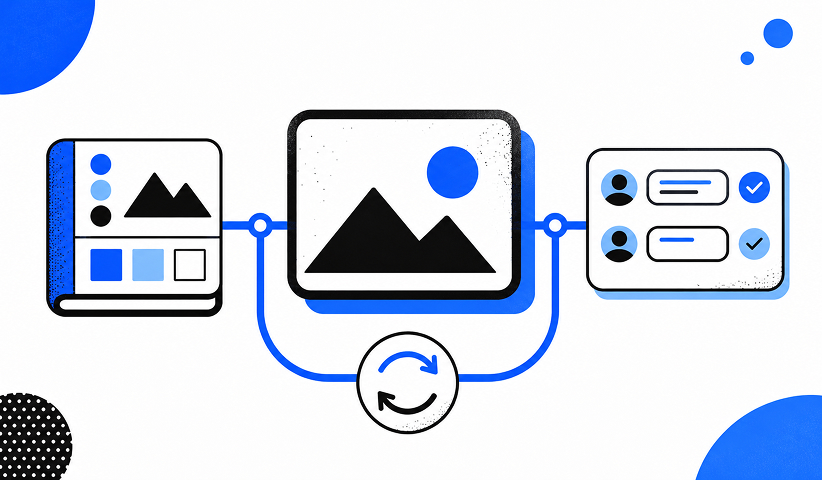

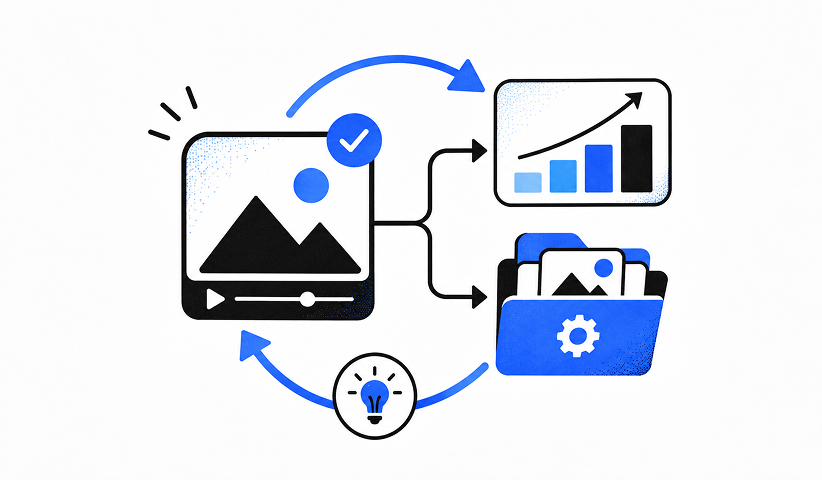

You do not need a large department on day one, but you do need every responsibility to have a name next to it. Common role areas include:
- Requester or campaign owner: Defines the business problem, audience, deadline and expected outcome.
- Creative operations or project lead: Triage requests, manage capacity, maintain the schedule and surface blockers.
- Strategist or brand owner: Ensure creative follows positioning, messaging and brand standards.
- Creators: Copywriters, designers, editors or developers produce and revise the work.
- Approver: One named decision-maker accepts the deliverable or returns specific changes.
- Channel owner: Publishes or deploys the asset and confirms specifications and tracking.
- Analytics or performance owner: Reports outcomes and feeds winning patterns back to the creative team.
These match the essential workflow roles most guides describe. In a lean team, one person may hold several. What matters is that the approval role is never ambiguous.
As volume grows, a dedicated creative operations lead takes over intake, resourcing, tool configuration, and throughput reporting. Canva’s growth marketing creative team used a creative operations lead and project managers to manage requests, production-board transparency and integrations while scaling output.
Removing approval bottlenecks
Approval chains usually grow reactively: one mistake leads to one more reviewer, and the reviewer never leaves. The fix is to design approval by risk instead of by habit.
A simple tiering model looks like this:
- Low risk: Template-based resized ads or routine social assets. One reviewer, with a sample target of 24 hours.
- Moderate risk: New campaign concepts or new landing page sections. Two specified reviewers, with a sample target of 72 hours.
- High risk: Regulated claims, sensitive content or major brand launches. Brand and legal or compliance reviewers, with escalation and a sample target of five business days.
- Governance note: These turnaround times are illustrative service targets. Adjust them to your team’s capacity, risk and legal review requirements.
This framework follows an approval tiering approach in which the point is to stop applying top-tier scrutiny to low-risk assets by default. Adapt the reviewers and times to your own organization, and write them where requesters can see them.
If your company sells in a regulated category, tier three deserves particular care. Put the legal or compliance reviewer in the workflow at the brief stage, not at the end, so claims are settled before production time is spent.
Other practical moves:
- Consolidate comments in one proofing location and assign a single reviewer to resolve conflicting feedback.
- Use locked templates and an approved asset library for routine production.
- Set clear limits on revision rounds and document what constitutes a change in scope.
- Publish response deadlines, escalation paths and the consequences of missed review windows.
- Bring legal and compliance into the brief stage for regulated assets rather than waiting until final approval.
Finding where your workflow loses time
Before buying tools, measure. A two-week flow audit is simple: pull every asset commissioned in the last quarter and record four timestamps for each: brief finalized, creative delivered, approval requested and approval granted. The gaps between them show where time goes. Many leaders discover the slowest step is waiting for approval, not making the work.
Then choose tooling by the problem you found. Creative workflow tools fall into categories: work management, creative production, review and proofing, digital asset management, file storage and agency operations. Pick based on where the workflow loses time and connect them so status and files stay in sync. A tool added before the process is defined only makes the confusion faster.
Metrics that show the workflow is working
Five measures cover speed, quality, efficiency and cost: cycle time, first-pass approval rate, revision rounds, reuse rate and cost per accepted asset. Use them this way:
- Cycle time: Median working days from accepted brief to approved asset; segment by asset type.
- First-pass approval rate: Percentage accepted without material rework, showing brief and production quality.
- Revision rounds: Average number of formal review cycles per deliverable, revealing feedback friction.
- Asset reuse rate: Share of assets derived from approved templates or reusable modules, indicating operational leverage.
- Cost per accepted asset: Production and review cost divided by deliverables that passed approval; compare only like-for-like formats.
Add performance signals as well: channel results, creative patterns that win, formats that underperform and drop-off points. Workflow metrics tell you whether you are efficient. Performance metrics tell you whether the work is worth making efficiently. You need both.
Want to learn more about brand platforms, Brand Strategy and Brand Identity? Keep reading!
If you need help with your companies brand strategy and identity, contact us for a free custom quote.
What scaling looks like in practice

A published example shows the scale of the gain. Canva’s creative operations team cut intake steps from 9 to 5, reduced production time by 40 percent and tripled creative output to 60,000 ads while supporting growth from 9 to 56 markets. That is one company’s reported result with its own tooling and volume, not a promise for every team. The pattern is what transfers: simplify intake, remove manual steps, and make status visible.
For a growing company the sequence is:
- Standardize request intake and brief requirements before increasing production volume.
- Assign a named workflow owner and define the exit condition for every stage.
- Build reusable templates and a searchable library of approved assets.
- Tier approval by risk and record turnaround expectations.
- Review throughput, quality and performance metrics monthly, and revise the process based on evidence.
The fifth step is the one most often skipped. Only 28 percent of creative teams run regular retrospectives, so most process changes are never checked against the problem they were meant to solve. A monthly 30-minute review of the five metrics above puts you ahead of most teams.
Our view: workflow without brand and performance is just traffic control
A tidy workflow can still produce forgettable work. We have seen the pattern: a team streamlines intake, speeds up approvals and ships more assets, but the assets do not share a positioning, and no one can say which ones moved revenue.
That is why we build creative around what we call brand-backed performance™. Branding, creative assets, digital platforms and marketing tactics are aligned from the start, so the brief carries the brand standard and the success metric together. When the brief says who the work is for, what it should do and how it will be measured, review becomes a question of which option performs best, not whose taste wins.
For ambitious startups, VC-backed companies and established brands, we think the creative workflow should be a growth system: transparent, collaborative and traceable from the first request to the result in the dashboard.
- Quincy Samycia
Where The Branded Agency fits
If your internal team is stretched, or your workflow exists on paper while output still depends on heroics, a partner who combines brand and performance work can carry the load. Our creative services cover performance-driven creative design and start from $4,000 per month. For teams that need volume with human-led quality, our AI Content Studio also starts from $4,000 per month. Growth Strategy starts from $8,500 per month, and all current offers are listed on our pricing page.
We work with growth-oriented companies across industries, with transparency and measurable outcomes at the center of every engagement. If you want your creative operations workflow tied to brand and results, talk to The Branded Agency.
Putting it into practice this quarter
A realistic first 30 days looks like this:
- Week 1: Audit the last quarter’s projects and identify where requests, reviews or handoffs stalled.
- Week 2: Launch one intake form, a standard brief and a shared production board with named owners.
- Week 3: Pilot low-, medium- and high-risk approvals on a small set of live requests; collect turnaround data.
- Week 4: Publish the asset library and baseline scorecard, then agree on next-month process changes.
Expect first-pass approval and cycle time to improve before anything else, because both depend on clearer briefs and clearer decisions. Brand and revenue results follow when those briefs are tied to a positioning and a measurable goal. For production volume, our guide to AI tools for content creation covers what we have tested for speeding up asset creation.
Frequently Asked Questions
What is the difference between creative operations and creative workflow management?
Creative operations is the whole system of people, process and tools that supports creative work. Creative workflow management is the part of it that moves work from request to approved asset, defining stages, owners and decision rules. Think of the workflow as the working path and creative operations as the function that designs and improves it.
What are the steps of a creative production process?
The core steps are intake, brief, triage and scheduling, production, review, approval, delivery, then measurement and reuse. Each step needs a named owner and an exit condition so work cannot move forward half-finished. A short debrief after complex projects feeds lessons back into the next brief.
When does a growing company need a creative operations role?
When requests arrive faster than one person can track, or when you see missed deadlines, repeated revisions and unclear ownership. A dedicated lead typically owns intake, resourcing, tool setup and throughput reporting. Until then, assign these duties explicitly to a project owner rather than leaving them informal.
How do you stop reviews from slowing down production?
Tier approvals by risk, name one approver per asset, keep feedback in one place and cap revision rounds. Set a turnaround window for each tier and an escalation rule for silence. Most delay comes from too many reviewers on low-risk assets.
Which metrics should we track first?
Start with cycle time and first-pass approval rate, since they show speed and brief quality quickly. Then add revision rounds, reuse rate and cost per accepted asset. Review them monthly and compare them with channel performance so efficiency never replaces effectiveness.
Sources
- Asana: Creative production process — https://asana.com/resources/creative-production
- Asana Help Center: Creative production workflow — https://help.asana.com/s/article/creative-production
- Adobe Workfront: Work management — https://business.adobe.com/products/workfront/main.html
- Nielsen Norman Group: Design systems — https://www.nngroup.com/articles/design-systems-101/
- W3C: Accessibility standards — https://www.w3.org/WAI/standards-guidelines/wcag/

Quincy Samycia
As entrepreneurs, they’ve built and scaled their own ventures from zero to millions. They’ve been in the trenches, navigating the chaos of high-growth phases, making the hard calls, and learning firsthand what actually moves the needle. That’s what makes us different—we don’t just “consult,” we know what it takes because we’ve done it ourselves.
Want to learn more about brand platform?
If you need help with your companies brand strategy and identity, contact us for a free custom quote.
We do great work. And get great results.
+2.3xIncrease in revenue YoY
+126%Increase in repurchase rate YoY



+93%Revenue growth in first 90 days
+144% Increase in attributed revenue




+91%Increase in conversion rate
+46%Increase in AOV




+200%Increase in conversion rate
+688%Increase in attributed revenue