Design System Governance: Roles, Models and Process
11/13/2026
Design
Build a design system that scales without brand drift by clarifying ownership, speeding up approvals, and creating contribution rules every team can follow.
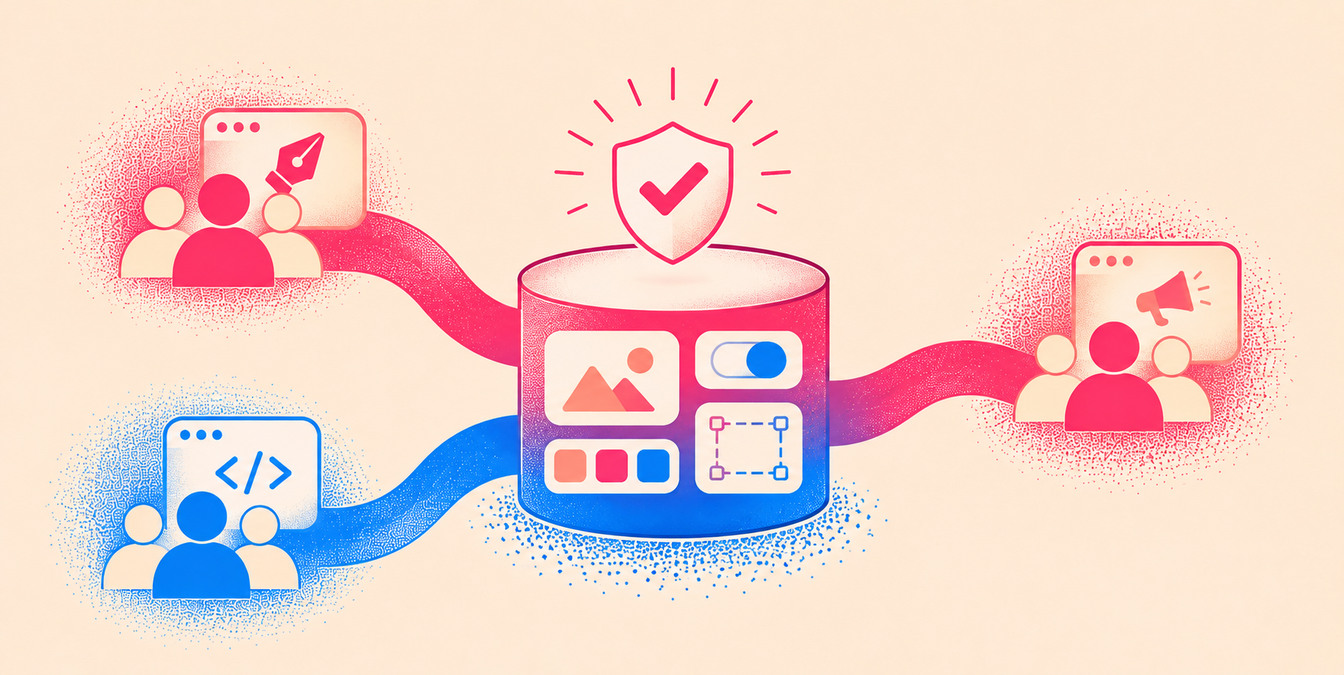
Design system governance is the set of roles, rules and routines that decide how your design system changes after it launches: who owns it, who approves additions, how teams contribute, and how old components retire. Without it, a system that looked consistent in month one drifts apart by month twelve. The fix is rarely more tooling. It is clear ownership, a model that fits your company’s size, and a change process that product teams trust enough to use.


What design system governance actually covers


This guide is written for the executive who sponsors the system: the CEO, CMO or marketing director at a scale-up who needs the brand, the website and the product to look and behave like one company. You do not need to configure the library yourself. You need to know which decisions to make, which questions to ask and what good looks like.
A design system is a shared library of components, patterns, tokens and guidelines that product, design, engineering and marketing teams build from. If you want the fundamentals first, our design system definition and our comparison of a design system versus a style guide cover them.
Governance is what happens next. A design system is not a static artifact: it evolves alongside the product, the organization and the underlying technology, so governance has to cover how it is created, owned, maintained and evolved over time. In practice that means answering five questions in writing:
- Ownership: Who is accountable for foundations, documentation, code, accessibility and releases?
- Decision rights: Which changes can a product team approve, and which require central review?
- Contributions: How does someone request, propose, test and publish a new component or pattern?
- Exceptions: Who can authorize a one-off variation, how is it recorded and when does it expire?
- Maintenance: Who monitors adoption, handles defects, announces version changes and retires outdated components?
When those answers live in people’s heads, decisions get made by whoever is loudest or most available. That informal approach works for a while. It tends to stop working as the company grows past two or three product teams, which is also when inconsistency starts to cost money in rework, slower launches and a brand that feels different on every surface.
Why it matters at the executive level
For a growth-stage company, the system is how brand strategy reaches production. A positioning decision made in the boardroom only becomes real when the landing page, the app, the email template and the sales deck all express it. Governance is the mechanism that carries that decision through every team that ships. It protects the investment you made in your visual identity system and your brand guidelines by making them enforceable and easy to follow.
Choosing a governance model
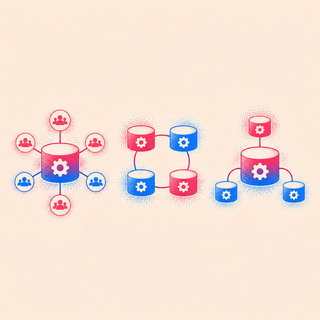
Three models cover most companies. The right one depends on how many teams build with the system, how many designers you employ, and how much product-specific variation you need.
- Centralized model: A dedicated system team makes decisions. Best for one or two products seeking fast consistency. Main risk: review requests become a bottleneck.
- Federated model: Representatives from product teams share decisions. Best when teams have mature design practices and protected contribution time. Main risk: diffuse ownership.
- Hybrid model: A core team governs tokens, accessibility and reusable components while domain teams maintain specialized patterns. Best for multiple products sharing one brand. Main risk: unclear boundaries between core and domain.
These are the three models described in current practitioner guidance, and the pattern of starting centralized and moving toward hybrid is the one most scaling companies follow.
Centralized: coherence first
A single team owns every component and every decision. That gives you the tightest consistency and the fastest decisions while the system is young. Design leader Josh Cusick argues that at a certain scale, around 20 or more designers, a dedicated system team becomes essential because a cohesive system needs full-time focus.
The risk is perception. Designer Vasil Hodzhev notes that the real danger of centralization is perceived gatekeeping: when the system team becomes a black box, product teams stop believing the system is for them and build workarounds. The remedy is visible turnaround times and a public request queue.
Federated: shared ownership
Product teams send representatives who decide together. This distributes the work and surfaces real product needs. It can suit smaller teams, but Cusick observes it is often not sustainable in the long run. Without clear principles, federated governance can slide into fragmentation, and maintenance becomes everyone’s problem and therefore no one’s job.
The BBC offers a well-documented federated example. In a 2025 InfoQ presentation, Sophie Beaumont described how people across teams can contribute to the design system while the system team acts as a central expert group that tends the whole. Every component has an owner, and ownership is recorded in the code repository so files cannot be merged without a team assigned. Mandatory ownership, she stressed, is what starts the right conversations.
Hybrid: the usual destination
In a hybrid model, a core team owns the foundations (color, type, spacing, core components, accessibility rules) while domain teams own patterns specific to their product. Hodzhev describes a practical tiered version:
- Core foundations: The system team owns typography, color, spacing, tokens, baseline accessibility and widely reused components.
- Shared patterns: System and domain representatives jointly review patterns reused across products, documenting exceptions and ownership.
- Domain-specific patterns: Product teams may own specialized solutions within agreed brand, accessibility and documentation guardrails.
He notes hybrid works when the tiers are explicit, understood and revisited. That last word matters: the tiers should be reviewed at least yearly, as the product and the company change.
Which one should you choose?
Use three questions. How many teams ship customer-facing work? How different are your products from one another? Can you fund a dedicated team? A single-product company with a small team should start centralized. A company with several products, a marketing team that ships its own pages and a growing engineering group should plan for hybrid from the start, even if the core team begins small.
Free Brand Health Audit
Make sure your brand is built to sell
Search has changed. Your customers aren't just Googling anymore. They're asking ChatGPT, Perplexity, Gemini and other AI platforms what to buy, who to trust and which brands they should consider.
If your brand isn't showing up clearly in those answers, you're already losing opportunities. Our free Brand Health Audit shows you where your brand stands across traditional search, AI search and brand positioning.

Sample brand audit
Live preview
Traditional search
72
AI search (GEO)
34
Brand positioning
58
Who owns the system, and who decides


Ownership is the single most common failure point. A system with no named owner becomes a side project, and side projects lose to roadmap pressure.
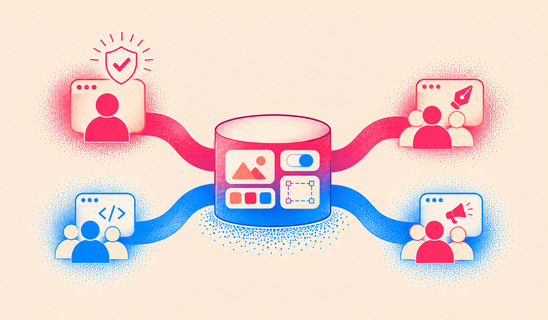
A workable ownership structure has four parts:
- Executive sponsor: Allocates staffing and budget, resolves cross-team conflict and reviews adoption quarterly.
- System owner or core team: Maintains foundations, the component backlog, releases, documentation and service targets.
- Domain contributors: Product, engineering and marketing representatives propose changes, test them in real contexts and own domain patterns.
- Approvers and specialists: Accessibility, legal or compliance and brand leads review changes when risk or content requires their expertise.
One mechanism worth borrowing is rotation. HubSpot rotated groups of four product designers onto its system team every six months, so that every designer eventually did a tour of duty and learned how to contribute.
A simple responsibility chart, listing who is responsible, accountable, consulted and informed for each type of change, removes most of the ambiguity. Keep it to one page.
Do not forget marketing
Most governance advice assumes the only contributors are product designers and engineers. At a growth-stage company, marketers also ship: landing pages, campaign creative, email and SMS templates, paid media assets. If they work outside the system, your brand fragments at the exact point customers meet it. Give marketing a seat in the decision structure, and make the system usable for their workflows. Our guide to unified brand systems explains why one system should span every touchpoint.
A change process teams will actually use
Governance fails when the path to getting something into the system is slower than building a one-off. Design leader Brad Frost’s governance process is the most widely referenced template, and it reduces to this flow:
- Request: Log the problem, affected users, business rationale, proposed outcome and requesting team in a visible queue.
- Triage: Check whether an existing component solves the problem; classify a genuine need as shared, domain-specific or an exception.
- Prototype: Assign a designer and engineer to build a small proposal with content, responsive and accessibility requirements.
- Review: Collect input from the system owner, affected domain teams and relevant brand or compliance reviewers.
- Build and test: Implement design and code together, validate keyboard and screen-reader behavior, document edge cases and run QA.
- Release and document: Approve the change, publish usage guidance and a changelog, and announce the version and migration needs.
- Adopt and measure: Help teams migrate, review usage and defects, and revisit the decision when product needs change.
Two executive-level points keep this from becoming bureaucracy. First, publish a target turnaround for each step, so requests do not vanish. Second, allow time-limited exceptions: governance should define how teams can diverge and when those divergences expire, so a shortcut does not become permanent.
Maintenance: versioning, deprecation and documentation
Governance is what keeps maintenance from being optional. The academic framing is useful here: a sustainable system gives every knowledge unit a clear owner responsible for its correctness and currency, and every significant change is justified, versioned and traceable.
Three habits do most of the work.
Version deliberately. Library-level versioning is the right starting point for most teams, according to a 2026 maintenance guide that describes a component lifecycle of propose, review, build, document, release, measure adoption and deprecate.
Retire components with notice. The same guide says deprecation is where teams most often drop the ball. A component should not vanish overnight. Announce the deprecation, publish a migration guide, allow at least one to two release cycles, then remove it in a major version. Front-end educator Steve Kinney suggests teams stay within one major version of current and have 90 days after a major release to adopt it, with codemods (small scripts that update code automatically) for mechanical changes.
Keep documentation alive. Documentation that is written once and never touched is the fastest route to a system nobody trusts. Tie documentation updates to releases, so they ship together.
Want to learn more about brand platforms, Brand Strategy and Brand Identity? Keep reading!
If you need help with your companies brand strategy and identity, contact us for a free custom quote.
Accessibility belongs in the governance rules

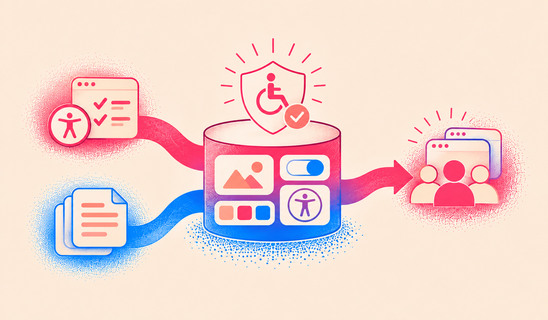
Accessibility is easiest to guarantee at the foundation: if the core components meet your standard, every page built from them inherits it. Write the standard into the rules for what can enter the core, and review it at each release. For marketing leaders, this also supports search performance, and this overview of web accessibility and SEO explains how the two connect.
Driving adoption
A well-governed system that nobody uses is still a failure. Adoption is a people problem more than a technical one, and the evidence points to a few consistent tactics:
- Publish a quick-start library with working examples, reusable templates and a clear path to request help.
- Offer office hours and monthly release demos so product, marketing and engineering teams can give feedback.
- Make contributions visible through an open backlog, named reviewers and response-time targets.
- Provide starter kits for landing pages, sales decks and campaign assets, not only application components.
- Pair adoption targets with practical incentives: less duplicated work, fewer review rounds and faster releases.
- Track bypasses and workarounds as evidence of missing components or an overly slow approval process.
How to tell whether governance is working
Executives need a small set of signals, reviewed on a schedule, rather than a dashboard nobody opens. Use these four groups:
- Coverage: Percentage of production screens, pages or campaigns built with approved components. Shows whether the system is becoming the default.
- Adoption by team: Usage and contributions from product, marketing and engineering groups. Identifies teams that need better support.
- Responsiveness: Median days from request to decision and decision to release. Reveals bottlenecks in the governance process.
- Quality: Accessibility test pass rate, post-release regressions, expired exceptions and inconsistencies in periodic audits. Shows whether changes are reliable.
Set a baseline in the first quarter, then review quarterly. A rising count of exceptions, a growing request backlog or one team that never contributes are early warnings that the model needs adjusting, usually toward more explicit ownership or a clearer core-versus-domain line.
Our perspective
We build brand and performance as one system, and we have a firm view on governance: it is a brand decision before it is a design decision.
A design system is where your positioning becomes repeatable. If the rules for changing it are vague, every team interprets the brand for itself, and your customers see a different company on the website, in the product, in the inbox and in the ad. We call the alternative brand-backed performance™: branding, creative assets, digital platforms and marketing tactics aligned, so results are measurable and traceable.
That is why we push leaders to treat governance as a leadership topic. Name an owner. Put marketing and product in the same decision structure. Write down what is core and what is flexible. Review it as the company grows, because the model that fits a ten-person team will not fit a hundred.
Done well, governance does not slow your teams down. It lets them move quickly without second-guessing the brand.
- Quincy Samycia
Putting governance in place with Branded
Governance sits at the point where brand strategy, creative and your digital platforms meet, and that is where we work. We combine branding, creative design, web development and performance marketing for ambitious, growth-oriented companies, so the rules you set for the system carry through to the pages, campaigns and lifecycle messaging that customers actually see.
If your system needs to be built, repositioned or extended across the site, see our strategic website development and branding services. Creative Services start from $4,000 per month and Growth Strategy from $8,500 per month, with all offers listed on our pricing page.
If you want a system that holds together as you scale, talk to The Branded Agency.
Frequently Asked Questions
What is the difference between design system governance and design system maintenance?
Governance defines who decides and how decisions are made. Maintenance is the ongoing work those decisions direct: fixing components, versioning releases, updating documentation and retiring old patterns. Governance without maintenance is a policy nobody executes, and maintenance without governance is a stream of unplanned changes.
When does a company need formal governance?
The usual trigger is growth in the number of teams. Informal, availability-driven decisions tend to stop working once you pass two or three product teams. If marketing, product and engineering each ship customer-facing work, start earlier and write the rules down.
Which governance model is best for a scale-up?
Most companies start centralized to build coherence and move toward hybrid as teams multiply, with a core team owning foundations and domain teams owning product-specific patterns. A single-product company can stay centralized longer. The deciding factors are the number of teams, the variety of products and whether you can fund a dedicated system team.
How do you get teams to adopt the design system?
Make contribution easy and visible. Regular office hours, an open monthly demo, a clear path from consumer to contributor, and rotation of designers through the system team all raise adoption. When teams build workarounds, treat it as feedback on what the system is missing.
How should marketing teams participate in design system governance?
Give marketing a named representative and approved templates for landing pages, email, social and paid campaigns. Marketing should propose shared needs through the same review process while retaining controlled flexibility for channel-specific formats.
How often should a design system governance model be reviewed?
Review operational metrics and exceptions quarterly, and reassess the centralized, federated or hybrid ownership model at least annually or after major organizational changes. Revise decision rights when the number of products or contributing teams changes.
Sources
- Brad Frost, A Design System Governance Process: https://bradfrost.com/blog/post/a-design-system-governance-process/
- U.S. Web Design System, Contribute to USWDS: https://designsystem.digital.gov/about/contribute/
- U.S. Web Design System, Code Guidelines: https://designsystem.digital.gov/documentation/code-guidelines/
- W3C WAI, Web Content Accessibility Guidelines 2.2: https://www.w3.org/TR/WCAG22/
- Semantic Versioning specification: https://semver.org/

Quincy Samycia
As entrepreneurs, they’ve built and scaled their own ventures from zero to millions. They’ve been in the trenches, navigating the chaos of high-growth phases, making the hard calls, and learning firsthand what actually moves the needle. That’s what makes us different—we don’t just “consult,” we know what it takes because we’ve done it ourselves.
Want to learn more about brand platform?
If you need help with your companies brand strategy and identity, contact us for a free custom quote.
We do great work. And get great results.
+2.3xIncrease in revenue YoY
+126%Increase in repurchase rate YoY




+93%Revenue growth in first 90 days
+144% Increase in attributed revenue




+91%Increase in conversion rate
+46%Increase in AOV




+200%Increase in conversion rate
+688%Increase in attributed revenue