Functions of Marketing: Key Functions, Examples, and How They Drive Business Growth

08/05/2026

Marketing Strategy

Discover how the seven core functions of marketing work together to strengthen your strategy, improve customer acquisition and retention, and drive measurable business growth in an increasingly competitive market.

Geometric illustration of the core functions of marketing, featuring research, market management, promotion, selling, and financial strategy arranged in an interconnected circular system.

Successful marketing is built on more than great campaigns—it relies on a collection of interconnected functions that help businesses understand customers, create value, communicate effectively, and deliver products or services to the right people. From market research and product development to pricing, promotion, distribution, and customer relationship management, each function plays a critical role in supporting long-term growth. Understanding how these disciplines work together enables businesses to make better strategic decisions, improve customer experiences, and build marketing systems that adapt to changing markets and evolving consumer expectations.

Quincy Samycia
Play IconPause Icon
0:00
0:00

Understanding the Core Functions of Marketing

Abstract illustration combining customer insights, CRM, sales analytics, performance metrics, and business growth through interconnected charts and gears.
Stylized composition of market research and business analysis with charts, upward trends, and professionals reviewing performance data.
Geometric illustration of marketing communication featuring speech bubbles, a megaphone, digital content, and audience engagement.
No items found.

Key Takeways

  • The core functions of marketing, including market research, product management, promotion, pricing, distribution, selling, and marketing information management, work together to satisfy customer needs and fuel business growth.
  • Understanding these key functions helps a company build better marketing strategies, run high quality marketing campaigns, and make informed decisions.
  • Modern marketing functions rely heavily on information management, content marketing, customer data, and customer relationship management to build brand loyalty.
  • When the seven marketing functions work in harmony, they form a highly adaptable business engine that supports business success.
  • This guide covers practical examples, including email marketing, product launches, pricing decisions, and distribution channels.

What Are Marketing Functions?

Marketing functions are the major categories of work that marketing professionals use to understand a target audience, create value, communicate offers, and deliver products or services. Marketing functions are essential for creating value by satisfying customer needs and ensuring the overall success of a company.

The marketing process is a continuous cycle of researching a target market, building brand identity, creating campaigns, and analyzing performance. It relies on a strategic blend of analytical, creative, and technical functions to drive business growth.

Classic marketing theory often lists seven functions or eight functions, but in practice they overlap. A startup launching digital services in 2026 may use the same core ideas as a global brand, but with more automation, CRM, social media marketing, and analytics.

The Key Functions of Marketing

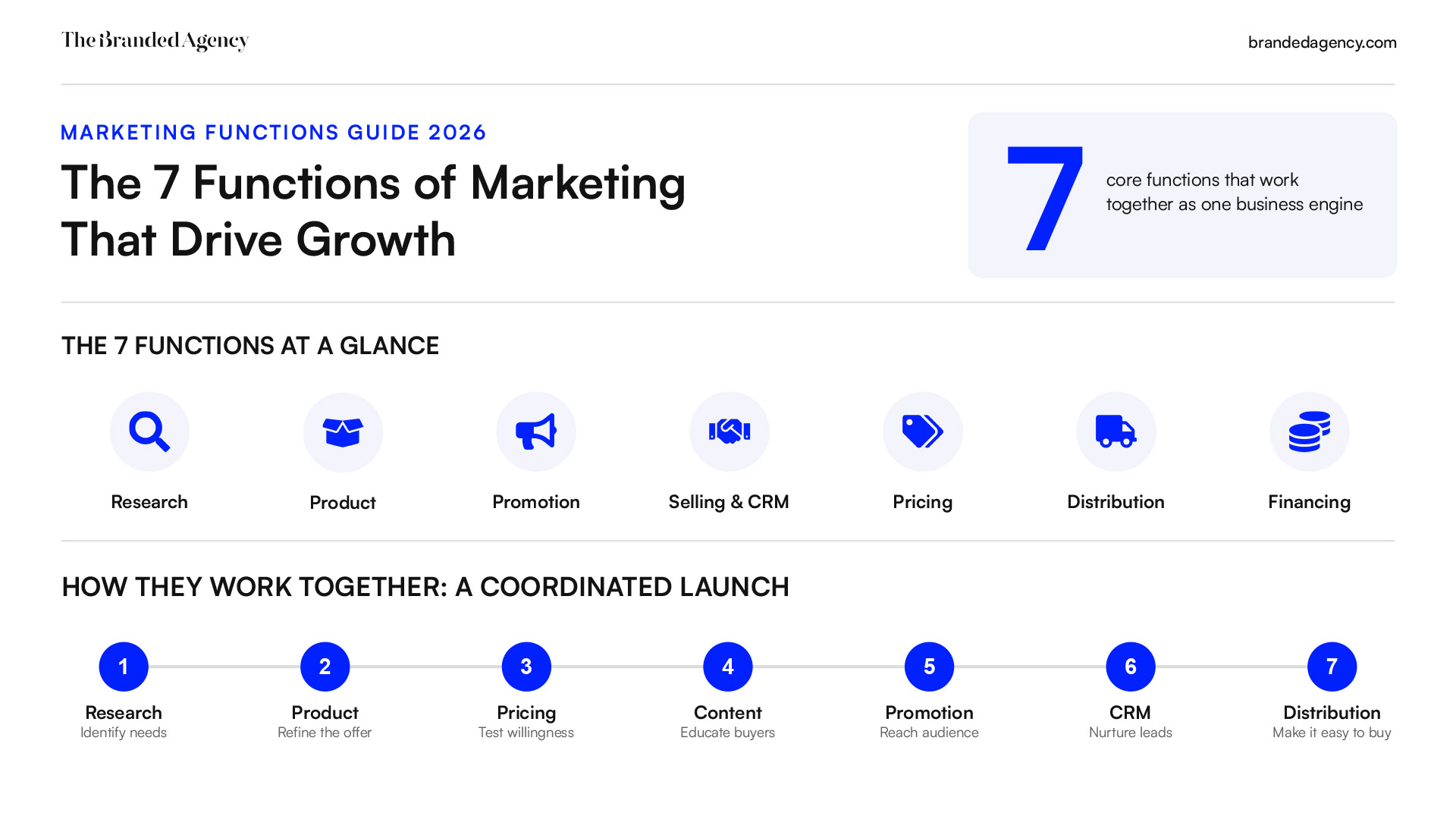
There are seven widely accepted marketing functions that contribute to the overall work of marketers: selling, product management, marketing information management, financing, and others.

  • Market research identifies customer preferences, consumer preferences, competitors, market demand, and industry trends.
  • Product management turns customer insights into useful products, features, packaging, and services.
  • Promotion helps create brand awareness through public relations, influencer marketing, content marketing, events, and social media campaigns.
  • Selling helps generate leads, nurture leads, turn potential customers into customers, and sell products in the market.
  • Pricing sets price points that balance value, cost, demand, and competitors.
  • Distribution gets products to the right distribution channels and supports the physical movement of goods.
  • Financing funds marketing activities, tools, campaigns, and growth.

These important functions support SEO, email marketing, paid ads, retail, partnerships, and other marketing functions.

Market Research: The Starting Point of Every Marketing Function

Abstract sales funnel illustration with charts, target graphics, analytics dashboards, and digital conversion elements representing lead generation.
Geometric pricing strategy illustration with premium pricing, discounts, sales messaging, and growth charts highlighting pricing optimization.
Abstract workflow diagram showing digital marketing automation, content distribution, messaging systems, and connected communication channels.
Geometric illustration of brand management featuring customer profiles, brand assets, security, growth metrics, and performance analytics.

Market research is the process of collecting and analyzing information about consumer preferences, needs, and behaviors, which is essential for informing marketing strategies. Conducting market research helps many businesses gather information before investing in product launches, pricing strategy, or a marketing campaign.

Effective market research can involve various methods such as customer surveys, A/B testing, and focus groups to gather insights that inform product development and marketing strategies.

Market research plays a foundational role in interpreting data about consumer preferences and helps businesses identify market segments by forecasting demand and analyzing competitors.

Common methods include:

  • Surveys to understand customer needs and buying motivations.
  • Interviews and focus groups to hear customer language directly.
  • Analytics tools to see how users move through a marketing funnel.
  • A/B testing to compare landing pages, ads, offers, or messages.
  • Competitive analysis for analyzing competitors and positioning.

In 2026, marketing teams increasingly use real-time analytics, social listening, feedback tools, and machine learning to stay ahead of fast-changing behavior.

For example, a food brand might test two flavors in a limited region before a national launch. A SaaS business might test two onboarding emails before rolling out a full email marketing campaign.

Product and Service Management

Product management covers planning, developing, improving, and retiring products or services. It turns customer insights into a value proposition that people understand and want.

Marketing often works with product design, R&D, support, and operations to decide:

  • Which features solve real customer problems.
  • Which packaging or branding improves perceived value.
  • Which updates are needed as customer needs shift.
  • Which products are in introduction, growth, maturity, or decline.

For example, a software company may add a reporting dashboard after users repeatedly request better visibility. A snack company may launch a new flavor after research shows rising demand in a specific segment.

Product decisions also shape the brand. Good packaging, clear positioning, and reliable service delivery can improve customer satisfaction before promotion ever begins.

Want to learn more about brand platforms, Brand Strategy and Brand Identity? Keep reading!

If you need help with your companies brand strategy and identity, contact us for a free custom quote.

Promotion and Integrated Marketing Campaigns

Abstract marketing performance dashboard with ROI metrics, conversion rates, growth charts, and business analytics visualizing campaign effectiveness.

Promotion is a key function of marketing that focuses on fostering brand awareness and educating target audiences about a brand’s products or services.

Promotional strategies can include a variety of activities such as designing print ads, managing social media campaigns, hosting events, and producing content like eBooks or infographics.

Modern promotion uses integrated campaigns across various channels:

  • Awareness: ads, public relations, influencer marketing, events, and social media marketing.
  • Consideration: guides, comparison pages, webinars, case studies, and content marketing.
  • Conversion: discounts, retargeting, email marketing, demos, and sales offers.

Effective promotion requires the support of other marketing functions to be successful, as it often involves collaboration across different areas of marketing.

For example, a 2026 B2B campaign might use a webinar to attract customers, an ebook to educate them, and follow-up emails to nurture leads. McKinsey has noted rising interest in community-led, conversational, and user-generated formats in modern promotion.

Selling and Customer Relationship Management (CRM)

Selling turns interest into revenue. The sales team helps prospects compare options, understand the offer, and make a confident buying decision.

Customer relationship management (CRM) involves managing interactions with potential and existing customers to foster loyalty and enhance customer satisfaction. Effective CRM strategies focus on delivering personalized experiences by tracking customer behavior, preferences, and purchase history.

CRM systems help businesses nurture good relationships with customers through targeted email campaigns, engagement initiatives, and loyalty programs. A key goal of CRM is to enhance customer retention, encouraging repeat purchases and recommendations to others, which ultimately increases profitability.

CRM supports:

  • Better timing, such as calling after a prospect downloads a whitepaper.
  • More relevant offers based on purchase history.
  • Cross-selling and up-selling.
  • Building relationships beyond one-time transactions.

Many organizations now treat CRM as a central part of sales and marketing, not just a database.

Pricing as a Strategic Function of Marketing

Pricing is a complex function of marketing that requires businesses to consider factors such as production costs, customer demand, and competitor pricing to determine the optimal price for their products or services.

Establishing a price for a product ideally finds a balance between customers’ perceptions of value and the actual cost of production, while also considering competitors’ pricing strategies.

Common pricing methods include:

  • Penetration pricing for startups that want market share.
  • Premium pricing for luxury or high-trust brands.
  • Subscription pricing for SaaS and membership businesses.
  • Bundles and discounts for specific promotional activities.
  • Usage-based pricing when value grows with usage.

Effective pricing strategies can lead to increased cash flow, but sometimes a lower price point can generate more income than a higher price point, depending on market conditions and customer willingness to pay.

Pricing should always match positioning. A low-cost brand and a premium brand cannot use the same pricing message without confusing customers.

Distribution and Place: Getting Products to Customers

Distribution involves making products available for sale to consumers through wholesalers and retailers, aiming to facilitate easy access for customers.

The primary goal of distribution is to ensure that products reach the end customer efficiently, which requires identifying appropriate geographical locations and establishing effective distribution channels.

Marketers help choose distribution channels such as:

  • Retail stores.
  • E-commerce websites.
  • Online marketplaces.
  • Direct-to-consumer stores.
  • Partner networks.
  • Wholesalers and retailers.

Effective distribution strategies require collaboration across departments to ensure that products are delivered to consumers in the intended manner, enhancing customer satisfaction and sales.

For example, a consumer brand may shift more inventory to online marketplaces in 2025–2026 as e-commerce demand rises. But if promotion creates demand and supply chain management cannot keep up, stockouts can hurt revenue and reputation.

Marketing Information Management and Data-Driven Decisions

Marketing information management is the function that collects, organizes, analyzes, and helps teams store data for better marketing decisions.

Marketing information management involves collecting, analyzing, and storing data about the company’s customer base, industry trends, and competitor activities, impacting all other marketing functions.

This is different from general information management because it focuses on customer data, campaign performance, competitors, and market signals.

Teams use MIM to track:

  • Conversion rates.
  • Customer lifetime value.
  • Cost per lead.
  • Campaign ROI.
  • Churn and retention.
  • Key performance indicators for each channel.

For example, if a landing page has a low click-through rate, marketing teams can adjust the headline, offer, or audience. If search trends change, a business can update its content strategy.

Privacy matters here. Teams should use secure storage, consent-aware tracking, and GDPR- and CCPA-aware practices when working with customer information.

Financing and Budgeting for Marketing Activities

Financing ensures there is enough budget to plan, execute, and scale marketing activities. It connects spending to expected returns.

A marketing team may allocate budget across paid media, email marketing, content creation, CRM tools, research, events, and automation. The goal is not just to spend more, but to prove which investments support sales, retention, and long term success.

For example, a business may justify a marketing automation platform by projecting fewer manual tasks, faster lead follow-up, and more revenue from nurtured prospects.

To secure funding, marketers should connect budgets to:

  • Revenue targets.
  • Campaign ROI.
  • Cost savings.
  • Customer retention.
  • Business growth.

How Marketing Functions Drive Business Success and Growth

Marketing drives business success by connecting products with the right audiences. The strongest results come when marketing strategies connect research, product, promotion, pricing, distribution, selling, and data management into one plan.

A coordinated launch might look like this:

  • Research identifies customer needs.
  • Product teams refine the service.
  • Pricing tests willingness to pay.
  • Content marketing educates buyers.
  • Promotion reaches the target audience.
  • CRM helps nurture leads.
  • Distribution makes the offer easy to buy.

This alignment can improve sales, brand reputation, customer relationships, and market share. It also helps a business adapt when customer behavior, competitors, or other factors change.

Challenges in Managing Marketing Functions

Executing the most important functions well is difficult, especially for small and mid-sized companies.

Common challenges include:

  • Limited budget and staff.
  • Fragmented customer data.
  • Poor alignment between marketing and sales.
  • Fast-changing digital platforms.
  • Weak coordination with operations.
  • Measuring only short-term wins.

For example, a business may run a successful promotion but face stockouts because distribution and supply chain management were not prepared. That creates unhappy customers even if the campaign worked.

Recognizing these issues helps teams improve processes, tools, and ownership.

Best Practices for Optimizing Marketing Functions

To improve the functions of marketing, start with practical changes:

  • Build integrated marketing strategies with shared goals, messages, budgets, and audiences.
  • Keep conducting market research through surveys, interviews, analytics, and pilot campaigns.
  • Use CRM, automation, and marketing information management tools to reduce data silos.
  • Set key performance indicators for research, promotion, selling, pricing, and retention.
  • Review performance monthly or quarterly, not only once a year.
  • Align the sales team, product teams, finance, and operations before major launches.
  • Use customer insights to improve the offer, not just the ads.

Conclusion: Integrating Marketing Functions for Long-Term Success

Geometric illustration of promotional marketing featuring a megaphone, target icon, growth arrow, and advertising elements representing campaign reach and customer acquisition.

How many marketing functions are there, and why do sources sometimes list different numbers?

Most modern sources refer to the seven marketing functions, while some older frameworks list eight or more by separating tasks differently. The core ideas remain similar: understand customers, manage products, set prices, promote, distribute, sell, manage information, and fund the work.

How do digital marketing channels fit into the classic functions of marketing?

Digital tactics such as SEO, social media, content marketing, and email marketing are tools inside broader functions like promotion, selling, and marketing information management. The channels changed, but the underlying marketing activities did not.

What is the difference between marketing functions and a marketing strategy?

Marketing functions describe what marketers do. A strategy explains how a specific business will use those functions to reach goals, choose audiences, position offers, and prioritize channels.

Can small businesses realistically manage all these marketing functions?

Yes, but usually in a simplified way. One person may handle several functions, or the business may outsource research, content, ads, or CRM setup. Start with basic research, clear positioning, consistent promotion, and simple measurement.

How often should a business review and update its marketing functions?

Review major plans at least annually, and review campaigns monthly or quarterly. Update your approach when new competitors appear, customer behavior changes, or performance data shows that current tactics are no longer working.

An image of the author Quincy Samyica

Quincy Samycia

As entrepreneurs, they’ve built and scaled their own ventures from zero to millions. They’ve been in the trenches, navigating the chaos of high-growth phases, making the hard calls, and learning firsthand what actually moves the needle. That’s what makes us different—we don’t just “consult,” we know what it takes because we’ve done it ourselves.

Want to learn more about brand platform?

If you need help with your companies brand strategy and identity, contact us for a free custom quote.

We do great work. And get great results.

DrTung’s
Breathed new life into a storied oral care brand with a smarter site and marketing for scalable growth.

+2.3x
Increase in revenue YoY

+126%
Increase in repurchase rate YoY

READ MORE
DrTung’s oral care product image with a smiling man, tooth powder tabs, and activated charcoal floss.
Smartphone on a textured blue surface displaying a DrTung’s ad with the text “Make the Switch” and an image of a woman holding herbal tooth powder tabs.
Flat lay of DrTung’s oral care products, arranged with a blue pouch on white tile.
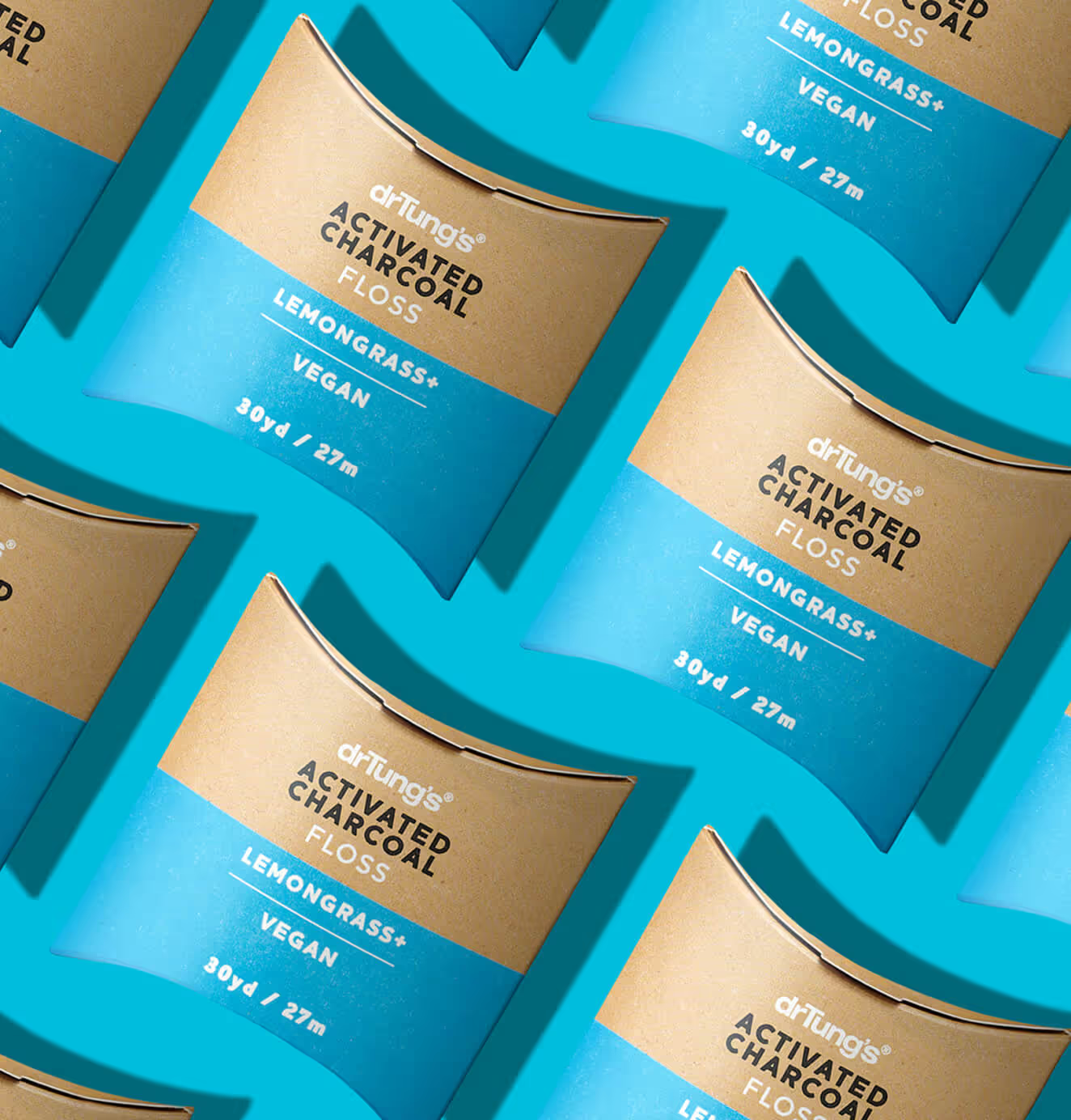
DrTung’s Activated Charcoal Floss packaging arranged in a repeating pattern on a bright blue background.
DrTung’s oral care product image with a smiling man, tooth powder tabs, and activated charcoal floss.
Smartphone on a textured blue surface displaying a DrTung’s ad with the text “Make the Switch” and an image of a woman holding herbal tooth powder tabs.
Flat lay of DrTung’s oral care products, arranged with a blue pouch on white tile.
DrTung’s Activated Charcoal Floss packaging arranged in a repeating pattern on a bright blue background.
Mary Louise Cosmetics
Scaled a heritage-inspired clean beauty brand with modern performance marketing and farm-to-face storytelling.

+93%
Revenue growth in first 90 days

+144%
Increase in attributed revenue

READ MORE
Mary Louise Lilac & Shea Body Butter jar with creamy texture and lavender sprigs on a beige surface.
A Mary Louise Miracle Serum bottle with a dropper cap, lying on a bed of small yellow flowers.
Mary Louise body butter promotional print materials with product photography and skincare application imagery.
Mary Louise Miracle Serum bottles arranged in a close-up pattern with pale yellow dropper caps.
Mary Louise Lilac & Shea Body Butter jar with creamy texture and lavender sprigs on a beige surface.
A Mary Louise Miracle Serum bottle with a dropper cap, lying on a bed of small yellow flowers.
Mary Louise body butter promotional print materials with product photography and skincare application imagery.
Mary Louise Miracle Serum bottles arranged in a close-up pattern with pale yellow dropper caps.
Eyecart
Made eye care feel modern, then marketed it like a DTC darling—with the results to match.

+91%
Increase in conversion rate

+46%
Increase in AOV

READ MORE
Eyecart optical care campaign image with a smiling woman holding a branded magnifying lens over one eye.
Eyecart billboard campaign featuring Blephaclean eye care wipes and healthy eye care messaging.
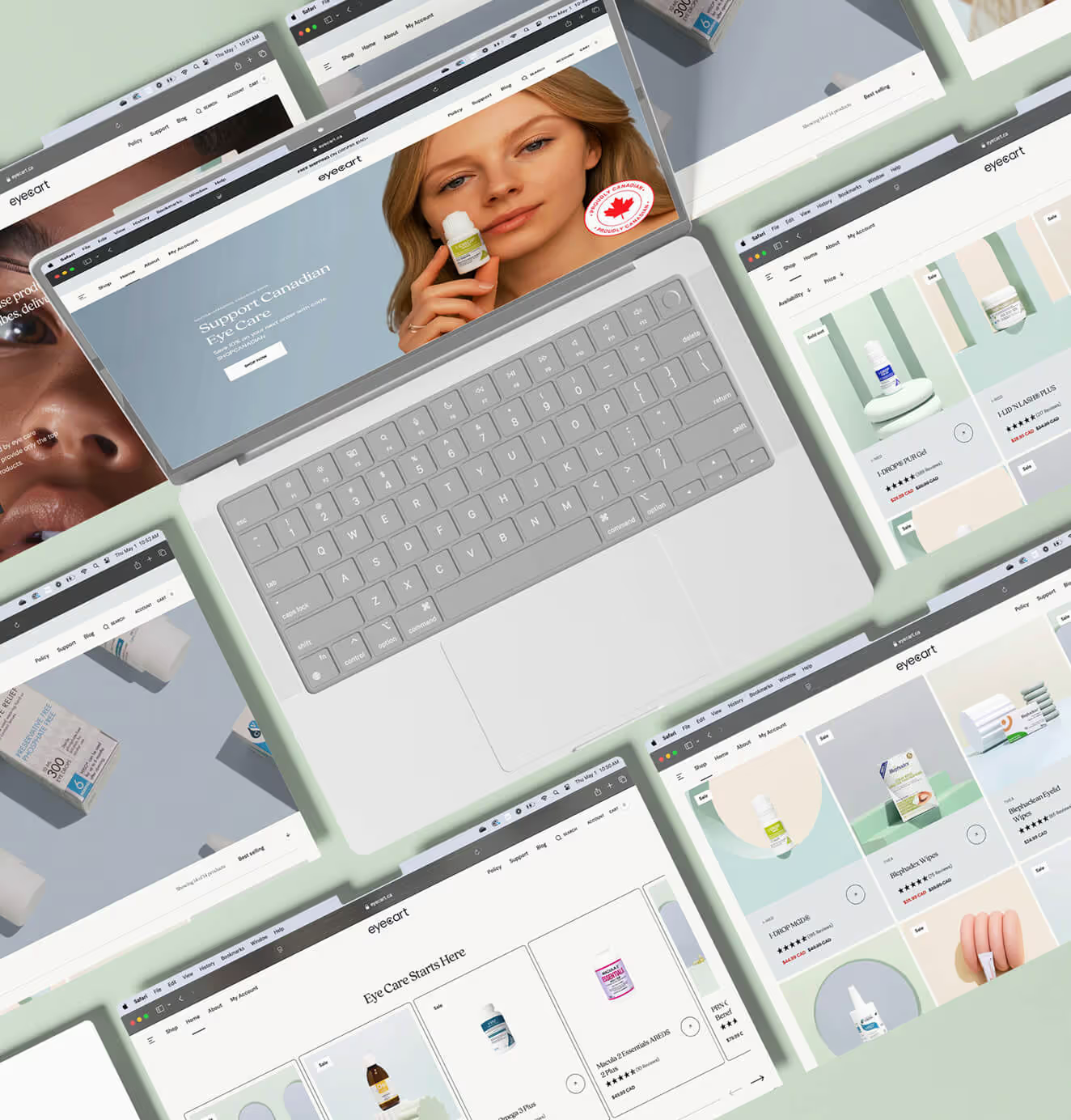
Multiple laptop screens display the Eyecart website, showcasing product pages and banners promoting eye care items.
Eyecart outdoor campaign posters featuring eye care products, skincare visuals, and modern branding.
Eyecart optical care campaign image with a smiling woman holding a branded magnifying lens over one eye.
Eyecart billboard campaign featuring Blephaclean eye care wipes and healthy eye care messaging.
Multiple laptop screens display the Eyecart website, showcasing product pages and banners promoting eye care items.
Eyecart outdoor campaign posters featuring eye care products, skincare visuals, and modern branding.
Lucky Girl Rosé
We turned a zero-carb rosé into a lifestyle brand that makes every moment worth celebrating.

+200%
Increase in conversion rate

+688%
Increase in attributed revenue

READ MORE
A bottle of Lucky Girl rosé wine nestled among pink and white flowers in a rustic outdoor setting.
Lucky Girl rosé picnic setup with wine bottle, fruit, sunglasses, and The Lucky Club booklet.
Lucky Girl rosé campaign visual with a wine glass, gold tray, red nails, and Pour Yourself Some Luck text.
Lucky Girl rosé wine bottle with floral label design and soft pink lifestyle styling.
A bottle of Lucky Girl rosé wine nestled among pink and white flowers in a rustic outdoor setting.
Lucky Girl rosé picnic setup with wine bottle, fruit, sunglasses, and The Lucky Club booklet.
Lucky Girl rosé campaign visual with a wine glass, gold tray, red nails, and Pour Yourself Some Luck text.
Lucky Girl rosé wine bottle with floral label design and soft pink lifestyle styling.