How to Build Brand Visibility Through SEO, Not Just Rankings
07/28/2026
Branding

.png)


Why Rankings Alone No Longer Drive Revenue



Free Brand Health Audit
Make sure your brand is built to sell

Why Top-3 Rankings No Longer Guarantee Traffic or Leads




Ten years ago, grabbing spot #2 on Google meant instant, predictable traffic. Now, you can hold that exact position, but it will have no positive impact on your click-through rate whatsoever.
Search result layouts changed completely. Google no longer presents ten plain blue links on a white screen. Instead, modern search pages pack in rich features designed to answer queries directly on Google's domain.
If your page sits at organic position #3, here is what actually appears on a desktop screen before a user ever sees your link:
- Four paid ads: Up to four Google Ads blocks sit at the top, taking up 400 to 600 pixels of vertical screen space.
- AI Overviews: Google generates a full-text answer at the top of the screen, pulling facts from multiple sites so searchers do not need to click out.
- Featured snippets: Instant answer boxes extract text directly onto the page, satisfying user curiosity on the spot.
- People Also Ask boxes: Expandable accordions push standard web links further down the page.
- Local packs and video carousels: Visual blocks grab visual attention long before a searcher reaches traditional results.
By the time a user scrolls past these features, your #3 organic link sits 1,200 pixels down the page. That is two full scroll lengths below the fold on a standard laptop screen.
Zero-click searches make this worse. Intent research published by Semrush shows that 74% of informational queries now resolve without sending a single visitor to an external site. Users extract quick answers directly from search summaries and bypass standard organic links entirely.
Other reputable SEO agencies mirror these findings in their research:
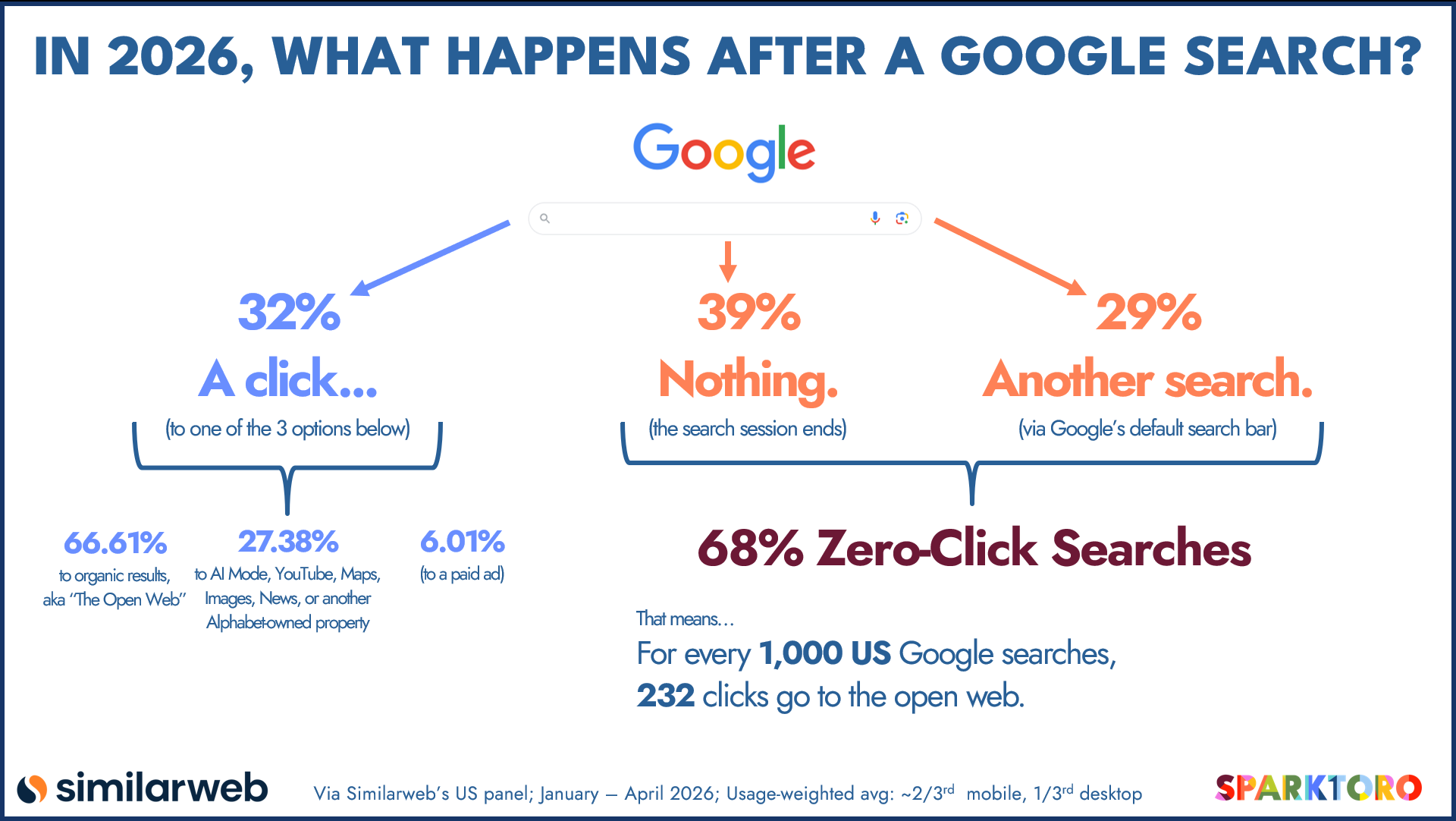
Source: Sparktoro
Check this on your own site. Open an incognito window and search your top three keywords. Count how many times you scroll before your link appears. If your site sits below two screens of ads and AI blocks, relying solely on standard rank tracking will not help you grow.
You need a multi-channel brand awareness strategy that focuses on capturing overall SERP footprint and building authority before a user ever clicks.
Want to learn more about brand platforms, Brand Strategy and Brand Identity? Keep reading!
What "Brand Visibility Through SEO" Actually Means

To fix your search strategy, you need to separate two concepts: holding a rank position and building brand visibility.
What "Not Just Rankings" Means
Traditional SEO focuses almost entirely on securing position #1 or #2 on search results pages. The problem is that high position numbers do not automatically translate to business growth.
You can rank first for low-intent keywords that generate zero revenue. Your search result can get buried beneath ads and AI overviews.
Even worse, a user might click your link, read a quick answer, and close the tab without ever noticing your company name. You achieved a top rank, but you built zero brand equity.
What "Through SEO" Means
Building brand visibility means using search engines to make your company name familiar, authoritative, and memorable.
Instead of tracking position tables alone, a brand-visibility approach focuses on four distinct goals:
- Search Feature Dominance: Appearing in AI Overviews, featured snippets, Google Images, YouTube videos, and People Also Ask boxes. You want your business name to show up multiple times on a single screen.
- Early-Stage Search Capture: Ranking for broad questions early in the buying process. When prospective customers see your site answering their questions repeatedly, trust builds before they are ready to purchase.
- SERP Control: Managing how your brand looks when users search for you directly. You ensure review ratings, third-party profile listings, and social channels present a clean image while driving qualified referral traffic back to your main site.
- Entity Recognition: Teaching search algorithms to understand your business as an established category authority, which places your brand inside generic product comparisons and topic recommendations.
A Real-World Example
Consider two software companies selling project management tools:
Company A tracks rankings. They rank #2 for "free project management checklist." A prospective buyer clicks, downloads a PDF, and closes the browser. The user never remembers Company A's name.
Company B targets visibility. They optimize for AI summaries, run digital PR campaigns around original survey data, rank video tutorials in search, and maintain strong ratings on Capterra. When that same buyer decides to shop for software 3 months later, they already recognize Company B as a trusted standard.
How to Build Brand Visibility Through SEO: A 4-Step Process
Shifting from keyword tracking to brand visibility requires changing how you plan, produce, and execute content distribution. Instead of optimizing pages for a single text link, you build assets that occupy multiple areas of the search page.
Follow these four steps to build a visibility-focused search campaign.
Step 1: Claim Multi-Asset SERP Real Estate
Do not limit your strategy to standard web pages. To increase brand visibility, identify keywords where Google displays rich features and create assets specifically designed to fill those spaces.
- Target featured snippets: Structure your answers in concise 40-word paragraphs, tables, or numbered lists directly under heading tags.
- Publish video content: Host videos on YouTube with keyword-optimized titles and timestamps to capture video carousels.
- Format for AI Overviews: Present clear factual statements and original statistics near the top of your articles so AI algorithms cite your brand as a source.
Also, to rank in Google’s AI Overviews, you need to target queries with more keywords, as people increasingly rely on conversational, natural queries in the past 2-4 years:
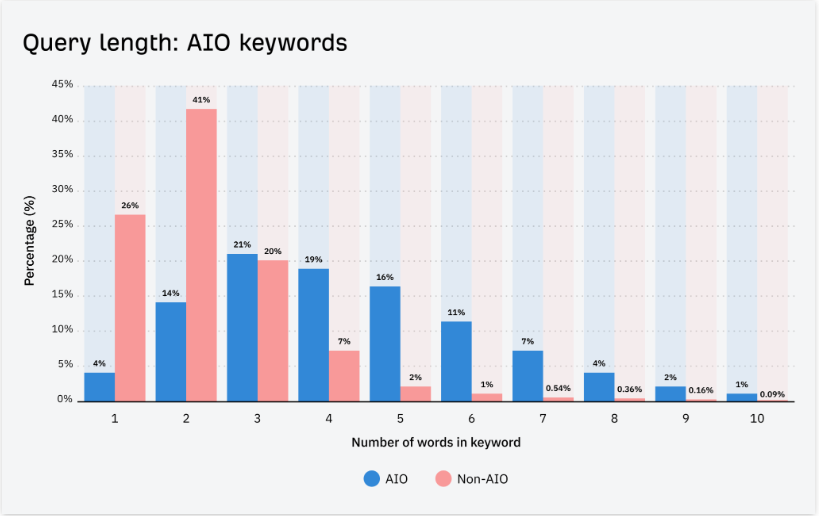
Source: Searchenginejournal
Step 2: Capture Early-Stage Informational Search
Target broad questions prospective buyers ask months before they are ready to purchase. Align these educational resources with your overall brand communication strategy so your content delivers a clear, consistent message across every touchpoint without forcing a pushy sales pitch.
When potential customers see your company name repeatedly answering their questions, you establish brand authority early in their journey. By the time they enter a buying cycle, your business is already top of mind.
Step 3: Own Your Branded Search Page
Your branded search page is a core extension of your digital branding. When a prospect searches your company name directly, you need complete control over what appears on that screen.
- Optimize review profiles: Claim and complete your listings on third-party review platforms like G2, Capterra, or Trustpilot. According to research on B2B buyer behavior from G2, over 90% of software buyers read third-party reviews before selecting a vendor.
- Manage sitelinks: Use clean site architecture and clear internal navigation so Google displays accurate sub-page links beneath your main domain result.
- Build brand profiles: Keep your social media channels active so your official profiles occupy the top five organic spots for your brand name.
Step 4: Build Entity Authority Through Original Research
Search engines organize information around entities, which are recognized real-world brands, places, and concepts. Building true SEO topical authority tells algorithms that your business is a primary source in your niche rather than just another blog aggregating existing information.
You can do so by conducting annual industry surveys, analyzing internal user trends, or publishing original benchmarks. When other publications quote your data, these unlinked and linked brand mentions signal to search engines that your company is a trusted authority in your niche.
Pick one high-traffic page on your site today. Search its target keyword in an incognito browser window and note which features appear on the page, such as video carousels, answer boxes, or AI summaries. Update that page over the next 30 days to target those specific visual elements instead of relying solely on body copy.
Top 5 Mistakes to Avoid

Pivoting to a visibility-first search strategy usually requires breaking old habits. Many marketing teams waste time and budget on tactics that look great in position reports but fail to build brand equity.
Here are five common mistakes to eliminate from your search strategy.
Mistake 1: Chasing High-Volume, Low-Intent Keywords
Targeting terms with 50,000 monthly searches looks good on paper, but broad informational queries often carry zero buying intent.
If you rank first for "what is project management," thousands of students and casual searchers will read a definition and leave. You waste resources capturing traffic that never converts or remembers your business name.
Focus instead on mid-funnel queries where users actively search for specific solutions, methodologies, or comparisons in your industry.
Mistake 2: Ignoring Your Branded Search Page
Many companies assume their search strategy is safe because their homepage ranks first when people search their brand name. They ignore what else appears on that screen.
Positive online reviews lead 73% of customers to trust a business more, with 57% visiting a company's website immediately after reading positive feedback. Without consistent reputation management, unmanaged review profiles and poor ratings on your branded search page will cause potential clients to drop out at the final stage of their decision process.
Mistake 3: Publishing Generic, Unbranded Content
Publishing generic content that simply summarizes top Google results gives searchers no reason to remember you.
When your articles lack original data, distinct opinions, or clear visual elements, users get their answer and close the tab without noting who provided it. Every piece of published content needs a clear brand signature, such as proprietary survey results, expert quotes, or custom diagrams.
The problem is not in the AI content alone, but in the lack of a human expertise. To rank well and drive leads, your content can be AI-generated by approximately 75%. The other 25% is what professional copywriters call a human touch, or human component. It includes several things:

Source: Adsagenz
Mistake 4: Treating Your Website as Your Only Search Asset
Modern buyers do not limit their research to your domain. They read Reddit threads, watch YouTube video reviews, and check comparison tables on third-party sites. Understanding how to build an online presence means expanding beyond your homepage and placing your brand across every platform your customers research on.
To build real visibility, optimize content across YouTube, partner blogs, and industry directories so your brand name appears across multiple SERP features.
Mistake 5: Tracking Average Rank Instead of Visibility
Relying on average keyword positions as your main success metric creates a false sense of progress. Holding position #4 for fifty low-value keywords tells you nothing about whether buyers recognize your business.
Research by Search Engine Journal demonstrates that organic click-through rates drop by up to 58% when AI Overviews and rich features occupy the top of the SERP. Tracking position numbers alone blinds you to whether searchers are actually seeing or clicking your links.
Audit your top ten most-visited organic pages today. Check if each page includes original data, custom visuals, or a clear brand perspective that sets it apart from basic web summaries. If a page offers only standard definitions, rewrite it to include proprietary research or expert commentary before running your next campaign.
Summary: The Future of SEO Belongs to Recognizable Brands
Search engine layouts will continue to evolve, but one factor remains constant: buyers choose companies they recognize. If your search strategy relies solely on securing a specific rank number on a spreadsheet, you are building on volatile ground.
Shifting your focus toward brand visibility protects your business against algorithm updates, AI summaries, and crowded ad blocks. When searchers see your company name consistently answering questions, providing data, and appearing across multiple search features, trust becomes a matter of time and repetition.
To ensure your business stays visible across changing search pages, integrate the following rules into your SEO campaign:
- Cover the entire search screen: Produce content for video carousels, answer boxes, and AI summaries to build a multi-asset presence beyond standard web links.
- Control your branded search page: Actively manage third-party review profiles, social channels, and site navigation to ensure a clean impression when users search your business directly.
- Publish original data: Conduct annual surveys and share proprietary data to train search algorithms and earn authority citations across your industry.
- Measure real business metrics: Evaluate campaign success using branded search volume, share of voice, and direct pipeline growth rather than average keyword ranks.
Take a look at your quarterly SEO goals today. Replace position-based targets with visibility metrics, and focus your team on building search assets that turn passive searchers into paying customers.
Frequently Asked Questions (FAQs)
What is brand visibility in SEO?
Brand visibility means making your company name recognizable across search results. Instead of just ranking a single link, you occupy featured snippets, AI summaries, video carousels, and review sites so users constantly see your brand.
Why are top rankings insufficient today?
Search pages now feature ads, AI overviews, and answer boxes above traditional organic links. You can hold position #3 and still sit two screen scrolls below the fold, resulting in zero clicks or user attention. On top of that, users frequently continue their conversations with an AI bot, like Google's AI Overviews.
How do you measure brand visibility?
Track branded search volume growth, organic share of voice, and direct website traffic. Monitor how often your business appears in AI Overviews and featured snippets rather than relying on average keyword position reports.
How long does brand SEO take?
While optimizing a single page takes three to six months, building noticeable brand visibility across search features usually requires nine to twelve months of consistent publishing, video creation, and digital PR. With the recent AI chatbot wave, content creation has become faster and easier, but it still requires competent human moderation and control.

Quincy Samycia
Want to learn more about brand platform?