How to Create Ads With ChatGPT: Prompts for Meta Ads and Google Ads
09/08/2026
Marketing Services
A 2026 guide with ready-to-use ChatGPT prompts for Meta Ads and Google Ads — customer research, ad copy, video scripts, testing plans, and performance analysis.
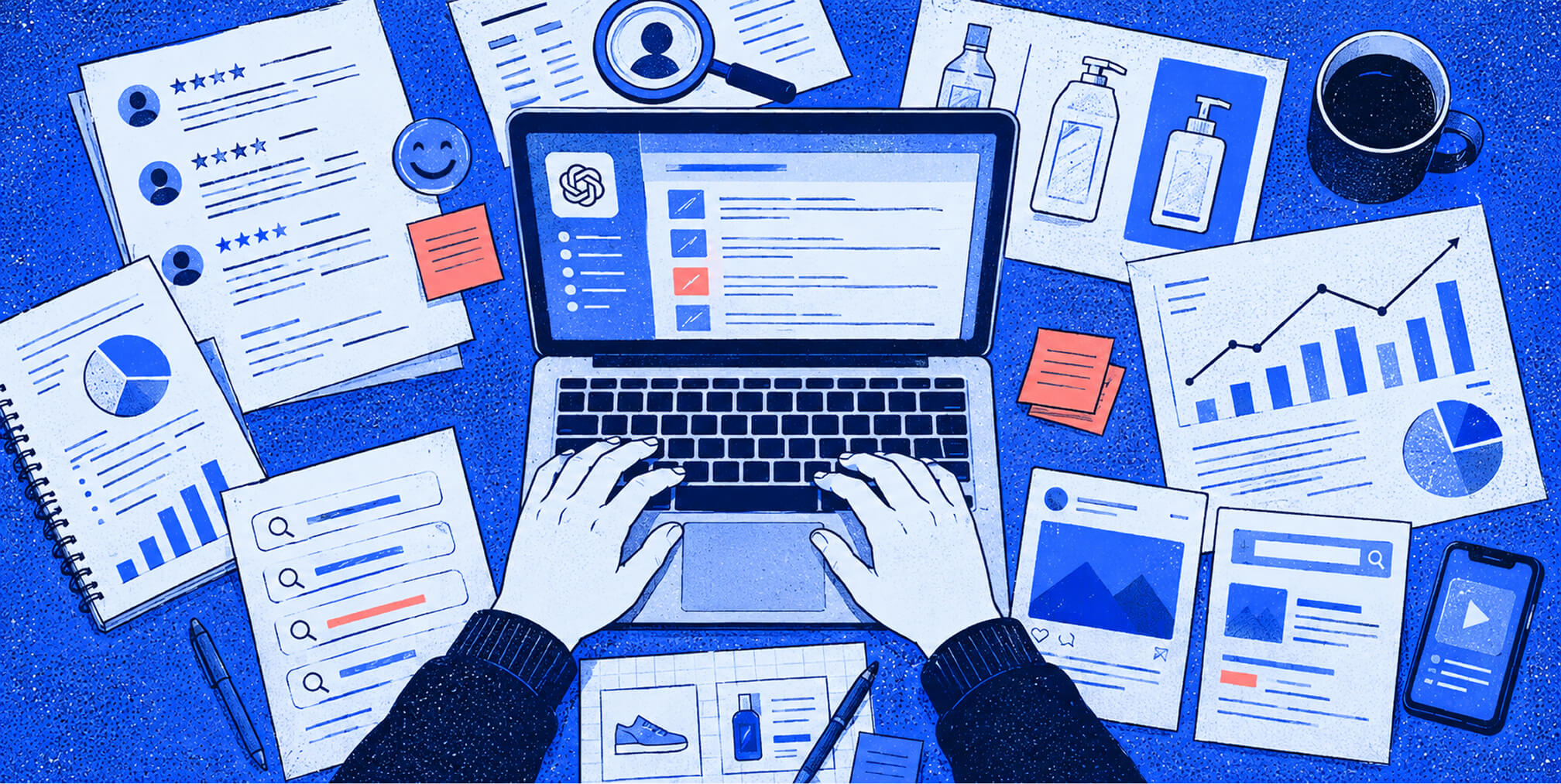
ChatGPT can help advertising teams move from a blank page to a structured campaign significantly faster.
.png)


Creating Ads With ChatGPT, Prompt Structure, and What Information to Provide

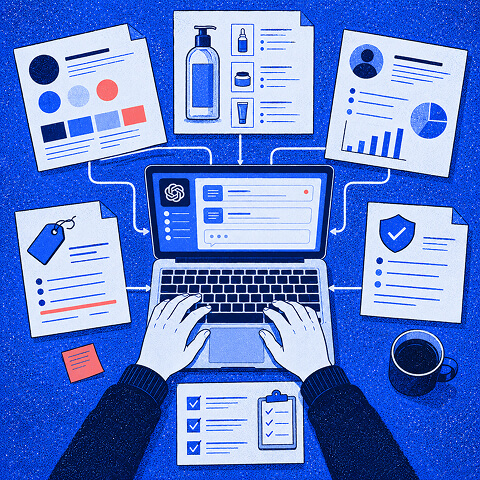

It can analyze customer research, identify advertising angles, develop campaign concepts, write headlines, create script outlines, generate variations and interpret performance data. But asking ChatGPT to "write a great ad" rarely produces strong advertising. Without detailed context, ChatGPT will usually return generic claims, familiar marketing language and copy that could belong to almost any competitor.
The quality of the output depends on the information you provide, the strategy behind the campaign, the specificity of your instructions, the quality of your customer insights, the strength of your offer, the review and editing process, and your understanding of the advertising platform. This guide explains how to use ChatGPT to create Meta and Google Ads, including a step-by-step workflow and reusable prompts for campaign strategy, ad copy, video concepts, testing and optimization.
Creating Ads With ChatGPT vs. Advertising on ChatGPT
These are two different activities. Creating ads with ChatGPT means using it to help develop advertisements for platforms such as Facebook, Instagram, Google Search, Google Shopping, YouTube, TikTok, LinkedIn and Microsoft Advertising. ChatGPT acts as a strategy, ideation, writing or analysis assistant. Advertising on ChatGPT means buying sponsored placements that appear below eligible ChatGPT responses through OpenAI Ads Manager. If you want to purchase placements inside ChatGPT, read our guide to how to advertise on ChatGPT. This article focuses on using ChatGPT to create and improve ads for other advertising platforms.
Can ChatGPT Create Ads?
Yes. ChatGPT can assist with many stages of advertising development, including customer research synthesis, campaign strategy, offer development, audience insights, advertising angles, creative concepts, Meta ad copy, Google Search headlines and descriptions, video hooks, script outlines, calls to action, landing-page briefs, creative variations, test planning and performance analysis.
OpenAI recommends treating ChatGPT as an iterative thought partner rather than expecting a perfect result from one request. Marketing teams can use it to organize campaign inputs, draft initial assets, explore several creative directions and refine work based on feedback, as described in OpenAI's marketing guidance.
ChatGPT should not replace brand strategy, customer research, creative direction, media strategy, legal review, platform expertise, fact-checking, human judgment or final approval. It accelerates the process. It does not take responsibility for the result.
Why Most ChatGPT Ads Sound Generic
A weak prompt often looks like this: "Write a Facebook ad for our skincare product." ChatGPT does not know which product, which customer, which problem, which stage of awareness, which market, which offer, which brand voice, which claims are approved, which competitors matter, which format is required, or which action the user should take. The model fills those gaps with common advertising patterns.
The result may include phrases such as "Unlock your potential," "Say goodbye to dull skin," "Transform your routine," "Discover the secret," "Elevate your experience," "Game-changing solution," or "Take your results to the next level." These phrases sound like advertising but communicate very little. A strong prompt gives ChatGPT enough context to make meaningful choices.
What Information Should You Give ChatGPT?
Before requesting ad copy, prepare a campaign input document.
Brand information: company name, brand positioning, value proposition, brand personality, voice and tone, words the brand uses, words the brand avoids, approved claims, prohibited claims, competitors, and reasons to believe.
Product information: product name, category, features, benefits, price, offer, availability, materials or ingredients, use cases, customer objections, proof, reviews, and limitations.
Audience information: primary customer, problem, desired outcome, awareness level, buying motivations, concerns, triggers, alternatives considered, language customers use, and reasons for delaying the purchase.
Campaign information: platform, objective, placement, format, funnel stage, geographic market, call to action, landing page, character limits, testing variables, and required disclaimers.
The more specific the input, the less generic the output is likely to be. OpenAI's prompt guidance recommends clearly identifying the task, supplying relevant context and specifying the preferred tone and format, per OpenAI's ChatGPT prompt-writing best practices.
The Best ChatGPT Prompt Structure for Advertising
Use this structure: Role (what perspective should ChatGPT adopt), Task (what should it produce), Context (what does it need to know), Audience (who is the advertisement for), Objective (what action should it generate), Constraints (what rules must it follow), Format (how should the answer be organized), Evaluation (what makes the result strong), and Iteration (ask for several directions before polishing).
Advertising prompt template
Act as a senior performance creative strategist.

Task:
Develop advertising concepts for [product or service] on [platform].

Brand:
[Brand description, positioning, voice and differentiators]

Audience:
[Customer description, problem, desired outcome and awareness level]

Product:
[Features, benefits, price, offer, proof and limitations]

Campaign objective:
[Sales, leads, awareness, traffic or another measurable action]

Placement and format:
[Feed image, Reel, Story, Search ad, YouTube video, etc.]

Approved claims:
[List approved claims]

Prohibited language:
[List prohibited claims, words or phrases]

Create:
[Number] distinct strategic directions. For each direction, include:
- Customer insight
- Advertising angle
- Core message
- Hook or headline
- Supporting copy
- Call to action
- Recommended visual concept
- Why the concept may work

Do not use generic phrases such as:
[List phrases to avoid]

Do not invent product facts, results, testimonials or statistics.
Flag any information that requires verification.
This prompt produces strategic directions rather than several superficial rewrites.
Free Brand Health Audit
Make sure your brand is built to sell
Search has changed. Your customers aren't just Googling anymore. They're asking ChatGPT, Perplexity, Gemini and other AI platforms what to buy, who to trust and which brands they should consider.
If your brand isn't showing up clearly in those answers, you're already losing opportunities. Our free Brand Health Audit shows you where your brand stands across traditional search, AI search and brand positioning.

Sample brand audit
Live preview
Traditional search
72
AI search (GEO)
34
Brand positioning
58
A Step-by-Step Workflow: Research, Awareness Levels, Angles, and Meta Ad Prompts
Step 1: Use ChatGPT to Analyze Customer Research
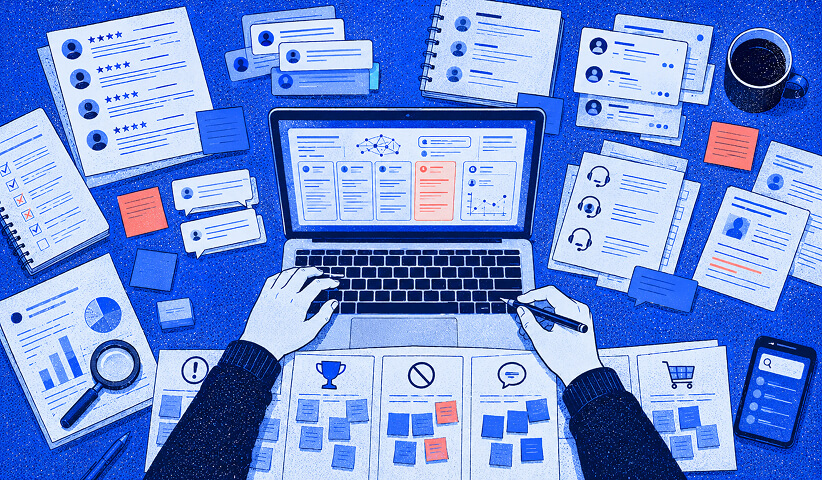
Strong advertising begins with customer insight. Upload or paste information such as reviews, survey responses, sales-call notes, customer-service tickets, Reddit discussions, social comments, search terms, competitor reviews, interview transcripts, and return reasons. Then ask ChatGPT to identify patterns.
Customer-research prompt
Analyze the customer research below for advertising insights.

Identify:
1. The five most common problems
2. The five most desired outcomes
3. The language customers repeatedly use
4. The most common objections
5. Emotional triggers
6. Purchase triggers
7. Existing alternatives
8. Reasons customers are dissatisfied with those alternatives
9. Statements that could become advertising hooks
10. Claims that would require proof before use

Separate direct evidence from your interpretation.

Do not invent frequencies or customer quotes. If a conclusion is weakly supported, label it as a hypothesis.

Customer research:
[Paste research]
This is a better use of ChatGPT than asking it to invent an imaginary customer persona.
Step 2: Identify Customer Awareness Levels
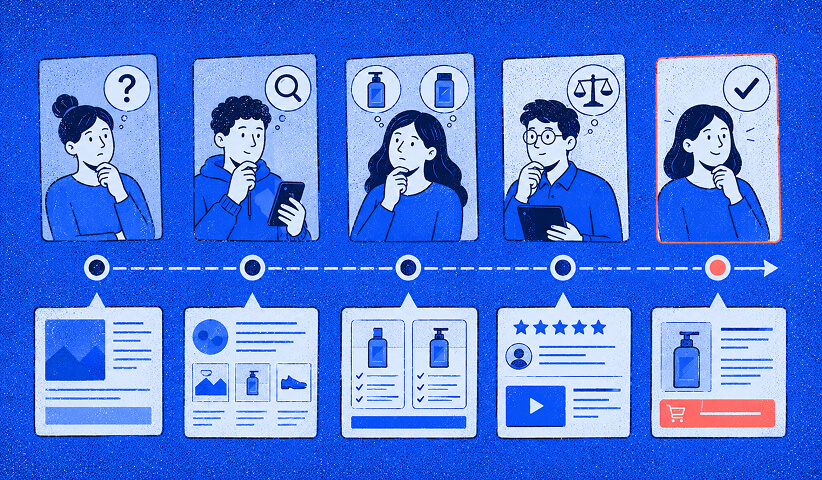
Customers need different messages depending on what they already understand. A useful framework includes: Unaware (does not recognize the problem), Problem aware (recognizes the problem but not the solutions), Solution aware (understands the category of solution), Product aware (knows the product but has not purchased), and Most aware (understands the product and may need an offer or reminder).
Awareness prompt
Using the customer research and product information below, create an advertising message for each awareness stage:

- Unaware
- Problem aware
- Solution aware
- Product aware
- Most aware

For each stage, provide:
- What the customer currently believes
- What the advertisement must accomplish
- The most relevant message
- One hook
- One supporting proof point
- One call to action

Do not make medical, financial or performance claims that are not explicitly supported.
A problem-aware customer may need education. A product-aware customer may need proof, differentiation or a stronger offer.
Step 3: Generate Advertising Angles
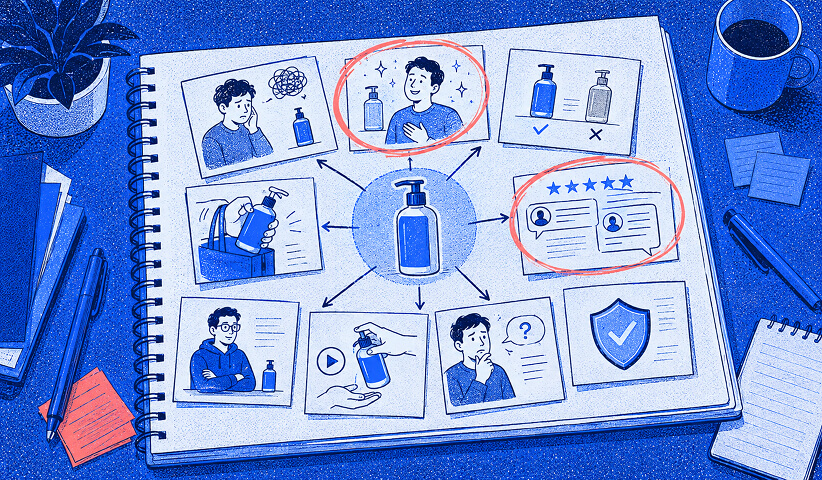
An advertising angle is the strategic argument behind the ad. Potential angles include problem, desired outcome, product mechanism, comparison, convenience, cost, time savings, social proof, founder story, contrarian belief, new discovery, identity, risk reduction, product demonstration, and objection handling.
Ad-angle prompt
Generate 12 distinct advertising angles for the product below.

Each angle must be based on a different customer insight or reason to purchase—not a wording variation.

For each angle, provide:
- Angle name
- Customer insight
- Core promise
- Supporting proof
- Best awareness stage
- Best platform
- Recommended format
- Primary risk or weakness

Rank the angles by:
1. Strategic strength
2. Available proof
3. Creative potential
4. Relevance to the customer

Product and research:
[Insert information]
The goal is not to produce 12 ads at once. It is to identify which arguments deserve creative development.
Step 4: Develop Creative Concepts
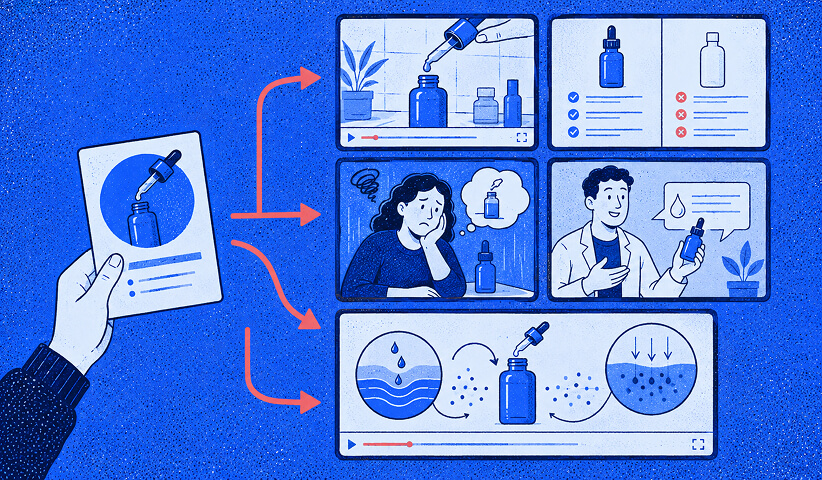
An angle is the argument. A concept is how the argument becomes an advertisement. For example, if the angle is that conventional floss is difficult to use between tightly spaced teeth, possible concepts include a close-up product demonstration, a side-by-side comparison, a customer frustration story, a dentist explanation, a "if your floss shreds, watch this" hook, or a product-mechanism animation.
Creative-concept prompt
Develop five visually distinct Meta ad concepts based on this angle:

[Insert angle]

For each concept, include:
- Concept name
- First-frame visual
- Opening hook
- Story progression
- Product demonstration
- On-screen text
- Voiceover outline
- Proof element
- Call to action
- Required footage
- Recommended duration
- Placement adaptations for Feed, Reels and Stories

The concepts must be understandable without sound.
Avoid concepts that require unsupported before-and-after claims.
How to Create Meta Ads With ChatGPT
Meta advertising is creative-led. ChatGPT can help with hooks, primary text, headlines, video scripts, storyboards, UGC briefs, creator briefs, static-ad concepts, carousel structure, testing plans, and comment-response libraries. It cannot determine which concept will perform best without actual campaign data.
ChatGPT prompt for Meta ad copy
Write Meta ad copy for the campaign below.

Platform:
Facebook and Instagram

Placement:
Feed and Reels

Objective:
Purchases

Audience:
[Describe customer]

Awareness stage:
[Choose one]

Product:
[Product information]

Offer:
[Offer]

Advertising angle:
[Angle]

Proof:
[Approved evidence]

Brand voice:
[Voice guidelines]

Create five versions with genuinely different opening hooks:
1. Problem-led
2. Product-demonstration-led
3. Social-proof-led
4. Contrarian
5. Outcome-led

For each version, include:
- Primary text
- Headline
- Description
- Call to action
- Recommended visual
- Claim-verification notes

Keep the opening sentence strong enough to communicate the idea before “See more.”
Do not invent customer quotes or product results.
ChatGPT prompt for a Meta video script
Write a 30-second vertical video ad for Instagram Reels and Facebook.

Product:
[Product]

Audience:
[Audience]

Customer problem:
[Problem]

Advertising angle:
[Angle]

Desired action:
[Action]

Brand voice:
[Voice]

Structure:
- 0–3 seconds: hook
- 3–8 seconds: problem
- 8–18 seconds: product demonstration
- 18–25 seconds: proof and differentiation
- 25–30 seconds: call to action

Provide:
- Visual direction for every scene
- Voiceover
- On-screen text
- B-roll requirements
- Caption
- Three alternative hooks

The video must work without sound.
Avoid generic stock-footage suggestions.
Do not include unsupported claims.
Want ChatGPT-assisted ads that still sound like you? Keep reading!
If you need a team that pairs AI-assisted workflows with real creative direction, contact us for a free custom quote.
Prompts for UGC, Static, and Carousel Ads, Plus Google Search and Shopping
ChatGPT Prompt for UGC Ads
User-generated-style advertising should not use fake experiences or invented testimonials. Use ChatGPT to create a creator brief, not to fabricate a customer story.
Create a UGC-style creator brief for this product.

The creator must not pretend to have used the product unless they have genuinely done so.

Include:
- Campaign objective
- Audience
- Key customer insight
- Product facts
- Approved talking points
- Prohibited claims
- Suggested opening hooks
- Product-demonstration requirements
- Questions the creator should answer in their own words
- B-roll list
- Call to action
- Required disclosure
- Deliverable specifications

Keep the creator’s wording flexible enough to sound natural.
ChatGPT Prompt for Static Meta Ads
Create six static Meta ad concepts for [product].

Each concept must communicate one clear message within two seconds.

For each concept, include:
- Headline displayed in the image
- Visual composition
- Product position
- Background or setting
- Supporting visual evidence
- Primary ad copy
- CTA
- Best audience
- Best awareness stage

Use six different strategic angles.
Do not repeat the same layout with different headlines.
ChatGPT Prompt for Carousel Ads
Create a seven-card Instagram and Facebook carousel for [product].

Objective:
[Objective]

Audience:
[Audience]

Angle:
[Angle]

Structure:
- Card 1: hook
- Cards 2–3: problem or insight
- Cards 4–5: solution and product mechanism
- Card 6: proof
- Card 7: offer and CTA

For every card, provide:
- Short on-image text
- Visual direction
- Supporting caption
- Purpose within the sequence

Keep each card understandable on its own while maintaining a connected story.
How to Create Google Search Ads With ChatGPT
Google Search advertising requires relevance, clarity and alignment with user intent. ChatGPT can help develop keyword themes, Responsive Search Ad headlines, descriptions, sitelinks, callouts, structured snippets, landing-page recommendations, negative-keyword hypotheses, and search-intent groupings. Do not use ChatGPT as the only source of keyword volume, CPC or competition data. It does not automatically have access to your current Google Keyword Planner information. Use real account and keyword data when available.
ChatGPT prompt for keyword grouping
Group the following Google Ads search terms by customer intent.

Create tightly related themes based on:
- Product or service
- Problem
- Location
- Purchase intent
- Comparison intent
- Informational intent
- Brand intent

For each group, provide:
- Suggested ad-group name
- Searcher intent
- Recommended landing page
- Message required
- Possible negative keywords
- Any term that should be excluded

Do not estimate search volume, CPC or competition.

Search terms:
[Paste search terms]
ChatGPT prompt for Responsive Search Ads
Write a Google Responsive Search Ad for this ad group.

Ad group:
[Name]

Keyword theme:
[Keywords]

Searcher intent:
[Intent]

Landing page:
[Page content or URL summary]

Brand:
[Brand information]

Offer:
[Offer]

Approved proof:
[Proof]

Create:
- 15 headlines within Google’s current character limit
- 4 descriptions within Google’s current character limit
- 6 callout assets
- 4 sitelink concepts with supporting descriptions
- 2 structured-snippet ideas

Requirements:
- Include the main keyword theme naturally
- Cover different benefits and proof points
- Avoid repeating the same message
- Keep every claim supportable
- Label any headline that may need pinning for compliance
- Count the characters in every asset
Always confirm character counts inside Google Ads before publishing.
ChatGPT prompt for Google Ads variations
Create three strategically distinct Responsive Search Ad directions for the same ad group.

Direction 1: Expertise and credibility
Direction 2: Business outcome
Direction 3: Specific customer problem

For each direction, provide:
- Core strategy
- 10 headlines
- 4 descriptions
- Recommended landing-page message
- Risks or weaknesses
- What result would validate the angle

Do not create minor wording variations.
ChatGPT prompt for Google Shopping titles
Product titles should be based on real feed requirements and accurate product data.
Rewrite the following product titles for Google Merchant Center.

Prioritize:
- Brand
- Product type
- Important attributes
- Size or quantity
- Material
- Colour
- Intended use
- Variant information

Do not:
- Add unverified features
- Add promotional language
- Use all caps
- Add fake urgency
- Invent product specifications

For each title:
- Provide the revised title
- Explain which attributes were prioritized
- Flag missing product data
- Keep within the required limit

Product data:
[Insert feed data]
Landing Pages, Testing, Performance Analysis, Common Mistakes, and Final Thoughts
Use ChatGPT to Create Landing-Page Briefs
Advertising performance depends on what happens after the click.
Create a conversion-focused landing-page brief for this campaign.

Audience:
[Audience]

Traffic source:
[Meta or Google]

Awareness stage:
[Stage]

Advertising angle:
[Angle]

Offer:
[Offer]

Customer objections:
[Objections]

Approved proof:
[Proof]

Create:
- Hero headline
- Hero supporting copy
- Primary CTA
- Section order
- Key message for every section
- Proof requirements
- FAQ topics
- Objection-handling section
- Mobile considerations
- Measurement requirements

Make the page continue the ad’s message rather than switching to generic brand language.
A Meta landing page may need to educate someone who did not begin with purchase intent. A Google Search landing page may need to confirm relevance and help a high-intent customer act quickly.
Use ChatGPT to Build a Creative Testing Plan
Testing too many variables at once makes results difficult to interpret.
Create a four-week creative testing plan for this campaign.

Budget:
[Budget]

Platform:
[Platform]

Primary objective:
[Objective]

Current benchmark:
[Benchmark]

Available concepts:
[List concepts]

Available formats:
[List formats]

Build a testing plan that isolates:
- Advertising angle
- Hook
- Format
- Offer
- Visual execution

For each test, provide:
- Hypothesis
- Control
- Variable
- Required creative
- Primary metric
- Secondary metric
- Minimum decision criteria
- What to do if it wins
- What to do if it loses

Do not invent statistical significance or recommend a fixed sample size without enough account data.
Use ChatGPT to Analyze Ad Performance
ChatGPT can help identify patterns in exported campaign data. Remove unnecessary personal or confidential information before uploading data. Follow your company's approved AI and privacy policies.
Analyze the attached advertising performance data.

Business objective:
[Objective]

Primary KPI:
[KPI]

Target:
[Target]

Campaign context:
[Context]

Identify:
1. Highest- and lowest-performing campaigns
2. Highest- and lowest-performing creative angles
3. Differences by placement
4. Differences by audience
5. Signs of creative fatigue
6. Potential tracking anomalies
7. Budget-allocation opportunities
8. Hypotheses that require further testing

Separate:
- Observations directly supported by the data
- Interpretations
- Recommendations
- Information that is missing

Do not claim causation from correlation.
Do not invent data that is not present.
Ask ChatGPT to Critique, Not Only Create
ChatGPT may be more useful as a critic than as a first-draft writer.
Critique this advertisement as a senior creative director and performance strategist.

Evaluate:
- Clarity
- Customer relevance
- Strength of insight
- Differentiation
- Credibility
- Brand voice
- Visual-copy relationship
- Platform suitability
- Offer strength
- Call to action
- Potential policy risks
- Unsupported claims

Do not rewrite it immediately.

First:
1. Identify the three strongest elements.
2. Identify the three biggest weaknesses.
3. Explain what information is missing.
4. Recommend the single highest-impact improvement.

Advertisement:
[Insert ad]
This prevents ChatGPT from changing everything before explaining the problem.
Create a Brand Voice Guardrail
ChatGPT needs more than "make it sound premium." Provide concrete rules.
Convert the following brand guidelines into an advertising voice checklist.

Organize the checklist into:
- Brand personality
- Sentence style
- Vocabulary we use
- Vocabulary we avoid
- Emotional tone
- Level of humour
- Claims and proof
- Calls to action
- Channel adaptations
- Examples that sound like us
- Examples that do not sound like us

Then use the checklist to evaluate every ad draft from 1–5 for brand alignment.

Brand guidelines:
[Insert guidelines]
What Not to Give ChatGPT
Do not upload confidential information unless your organization has approved the platform, account type and workflow. Sensitive information may include customer personal data, health information, private financial information, passwords, API keys, unreleased intellectual property, confidential client documents, employee records, legally privileged information, and private campaign data without authorization. An agency should establish clear rules about which clients and projects can use AI-assisted workflows.
Common ChatGPT Advertising Mistakes
Asking for one final ad immediately. Generate strategic directions first. Select the strongest direction before writing variations.
Providing no customer evidence. Do not ask ChatGPT to invent customer psychology when reviews, calls and search terms are available.
Generating too many similar variations. Ten rewrites of one generic concept do not create a robust testing program.
Letting ChatGPT invent proof. Never allow it to fabricate testimonials, statistics, awards, product results, clinical evidence, customer counts, or comparisons.
Ignoring the platform. A Google Search ad, Instagram Reel and ChatGPT ad require different creative logic.
Publishing without human editing. Every final asset should be reviewed for accuracy, brand voice, strategy and compliance.
Automating before establishing a winning message. Automation can scale weak creative just as easily as strong creative.
Using AI-generated imagery without review. Check product accuracy, packaging, logos, human anatomy, text, cultural representation, rights and permissions, and platform disclosure requirements. Google requires certain AI-generated product data and assets to be identified appropriately, depending on the format and jurisdiction. Advertisers should review current platform rules rather than assuming every AI-generated asset can be used without disclosure.
A Better ChatGPT Advertising Workflow
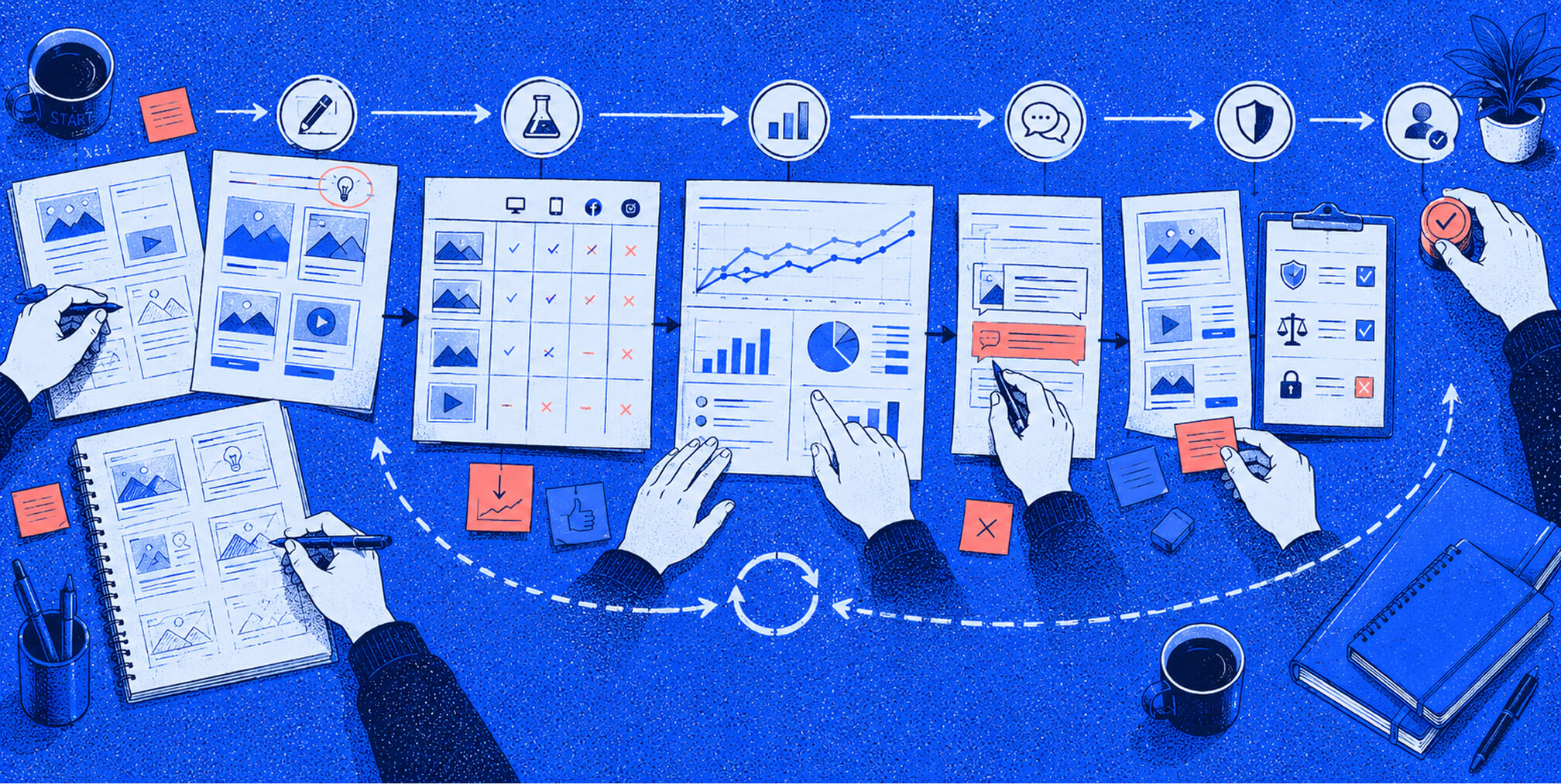
ChatGPT can support every stage, but humans remain responsible for evidence, direction, selection, approval, interpretation and final decisions.
FAQ
Can ChatGPT write Facebook and Instagram ads?
Yes. ChatGPT can draft Meta ad copy, headlines, video scripts, carousel structures and creative concepts. The output should be reviewed and tested by an experienced marketer.
Can ChatGPT create Google Ads?
ChatGPT can draft Responsive Search Ad assets, organize keyword themes and create extensions. Advertisers must verify character limits, claims, keyword data and policy compliance before publishing.
What is the best prompt for creating ads?
The best prompt includes the brand, customer, product, objective, platform, format, offer, proof, constraints and required output. There is no universal one-line prompt that produces the best ad for every business.
Can ChatGPT generate advertising images?
ChatGPT may be able to create or edit images depending on the account and available tools. Advertisers must review product accuracy, brand consistency, usage rights and platform policies.
Can ChatGPT create video ads?
ChatGPT can help create video concepts, scripts, storyboards, shot lists and on-screen text. Final production still requires visual direction, editing and quality control.
Will ads created with ChatGPT perform better?
Not automatically. Performance depends on customer insight, offer, creative, targeting, website experience and campaign execution. ChatGPT can increase speed and variation, but it does not guarantee results.
Do I need to disclose that ChatGPT helped write an ad?
Requirements depend on the platform, asset type, market and applicable regulations. Review current platform and legal requirements, especially for synthetic images, video, voices and realistic depictions.
Can ChatGPT replace an advertising agency?
ChatGPT can support research, ideation, writing and analysis. It does not replace strategy, media expertise, creative direction, production, accountability or experience managing real campaign performance.
What is the difference between creating ads with ChatGPT and running ChatGPT Ads?
Creating ads with ChatGPT means using it to develop advertising for another platform. Running ChatGPT Ads means buying sponsored placements inside ChatGPT through OpenAI Ads Manager.
Final Thoughts
ChatGPT can make advertising teams faster, but speed is not the same as effectiveness. The best use of ChatGPT is not asking it to replace the creative process. It is using it to organize customer evidence, explore strategic directions, generate meaningful variations, critique weak ideas, adapt concepts across platforms, analyze campaign data, and accelerate iteration.
The strongest advertisements still require a real customer insight, a credible offer, distinctive creative and human judgment. At The Branded Agency, we combine brand strategy, creative development, paid-media management and AI-assisted workflows to produce advertising that is both scalable and genuinely on-brand. Contact The Branded Agency to discuss creative strategy and performance advertising for your business.

Quincy Samycia
As entrepreneurs, they’ve built and scaled their own ventures from zero to millions. They’ve been in the trenches, navigating the chaos of high-growth phases, making the hard calls, and learning firsthand what actually moves the needle. That’s what makes us different—we don’t just “consult,” we know what it takes because we’ve done it ourselves.
Want to learn more about brand platform?
If you need help with your companies brand strategy and identity, contact us for a free custom quote.
We do great work. And get great results.
+2.3xIncrease in revenue YoY
+126%Increase in repurchase rate YoY

+93%Revenue growth in first 90 days
+144% Increase in attributed revenue




+91%Increase in conversion rate
+46%Increase in AOV

+200%Increase in conversion rate
+688%Increase in attributed revenue