MQL vs SQL: Definitions, Differences and Handoff Rules
11/19/2026
Marketing Strategy
Turn more marketing leads into sales conversations with clear MQL and SQL criteria, faster handoffs, and a qualification process both teams can trust.

An MQL (marketing qualified lead) is a contact who has shown interest in what you sell but is not ready to buy. An SQL (sales qualified lead) is a prospect that sales has vetted and judged ready for a direct sales conversation. HubSpot’s guide draws the line the same way. The definitions are the easy part. The hard part is agreeing, in writing, on what each one means inside your company, and who owns the lead at each point.


What is an MQL?



This guide is for CEOs, CMOs and marketing directors at growth-stage companies. It gives you the definitions, a side-by-side comparison, the criteria that qualify each lead, the handoff rules, and how to read your MQL-to-SQL conversion rate.
MQL stands for marketing qualified lead. It is a contact who has engaged with your marketing and looks like a potential customer, but has not yet shown enough intent to justify a sales call. Typical behaviors, as Shopify describes them, include ad clicks, content downloads, webinar attendance and repeat site visits.
Zendesk’s guide adds an important point: there is no single definitive set of criteria for an MQL, so the definition varies by company. That is not a flaw. It is the reason you have to write your own.
A useful MQL definition has two parts:
- Ideal customer fit: Match the agreed industry, company size, geography, role and account criteria. Record firmographic fit separately from activity.
- Meaningful engagement: Require evidence such as repeated product or integration-page visits, webinar participation or a relevant content download. Avoid qualifying solely on email opens.
- Promotion threshold: Define which combination of fit and behavior makes an MQL; document exclusions and exceptions so scoring is auditable.
Example: a VP of Marketing at a 200-person SaaS company, inside your target segment, downloads a benchmark report and returns twice to your integrations page. That is a strong MQL. A student who downloads the same report is not, however many emails they open.
What is an SQL?
SQL stands for sales qualified lead. In this context it has nothing to do with the database language. It is a prospect that sales has reviewed and found ready for an active sales conversation. Salesforce defines it as a lead flagged by a sales team member as likely to convert, typically after checking fit against the buyer persona, a solvable pain point and the classic BANT questions: budget, authority, need and timing.
Zendesk describes the SQL as a lead in the decision stage, with intent shown through pricing-page visits, cart activity or consultation requests. The signal is no longer “interested in the topic.” It is “evaluating a purchase.”
Example: the same VP of Marketing replies to a sequence, books a call, confirms a Q1 budget, names the CEO as the final approver and describes a specific problem with paid-media attribution. That lead is now an SQL.
MQL vs SQL at a glance
- Definition: MQL = marketing qualified lead; SQL = sales qualified lead.
- Decision owner: Marketing applies agreed fit-and-engagement rules for MQLs; sales confirms buying readiness for SQLs.
- Evidence: MQLs show target-account fit plus interest; SQLs demonstrate a real need and willingness to explore a purchase.
- Funnel position: MQLs tend to sit in awareness or consideration; SQLs are closer to evaluation and a sales conversation.
- Typical behavior: MQLs engage with webinars, content or product pages; SQLs request demos, discuss timing or confirm a purchase project.
- Next action: Nurture or route an MQL for review; assign an SQL to a discovery meeting, evaluation or opportunity workflow.
HubSpot places MQLs at the top-to-middle of the funnel and SQLs at the bottom. Monday.com’s guide adds a useful contrast: MQLs are often exploring next year’s budgets, while SQLs have immediate needs and defined timelines.
A shortcut that helps in executive meetings: an MQL is a prediction that someone might buy, and an SQL is a confirmation that they intend to. If you want to see where both sit in the broader journey, our glossary entries on the sales funnel and the marketing funnel cover the stages, and the qualified lead entry covers the term itself.
The criteria that qualify each lead
Qualifying an MQL: fit plus behavior
Most teams score MQLs on two axes and set a threshold. A common setup weights fit and behavior roughly equally on a 0 to 100 scale and promotes a lead at a score somewhere in the 60 to 75 range, depending on how much volume sales can handle. Treat those numbers as a starting point, since each company calibrates its own.
Write down three lists:
- Fit attributes: Target roles, account size, industry, territory, buying influence and current technology or use-case match.
- Intent signals: High-value page visits, event participation, product comparison activity, relevant replies and hand-raise requests.
- Exclusions and negative scoring: Students, competitors, unsupported markets, irrelevant roles, duplicates, existing customers and low-quality or automated activity.
- Scoring governance: Define the threshold, decay older activity, and review false positives and rejected leads with sales each month.
Revisit the exclusion list each quarter using your closed-lost data, so it reflects who actually fails to buy.
Qualifying an SQL: confirm the buying conditions
An SQL check is a conversation, not a score. The most widely used checklist is BANT:
- Budget: Is funding available or is there a credible route to obtaining it? Do not disqualify solely because the exact figure is undecided.
- Authority: Who influences, approves and signs the purchase, and can the contact introduce those stakeholders?
- Need: Which measurable business problem is the buyer trying to solve, and why now?
- Timeline: Is there a real milestone or decision window, and what must happen before a purchase can proceed?
- Next step: Record qualification evidence and agree on a meeting or action; if readiness is missing, return the contact to a defined nurture track.
BANT suits a quick first screen. For a larger deal, sales teams often move to deeper frameworks such as MEDDIC at the discovery stage. The practical point is to match the depth of the qualification to the stage. Asking a development rep to uncover a full decision process on a cold first call produces little.
Free Brand Health Audit
Make sure your brand is built to sell
Search has changed. Your customers aren't just Googling anymore. They're asking ChatGPT, Perplexity, Gemini and other AI platforms what to buy, who to trust and which brands they should consider.
If your brand isn't showing up clearly in those answers, you're already losing opportunities. Our free Brand Health Audit shows you where your brand stands across traditional search, AI search and brand positioning.

Sample brand audit
Live preview
Traditional search
72
AI search (GEO)
34
Brand positioning
58
Where the SAL fits



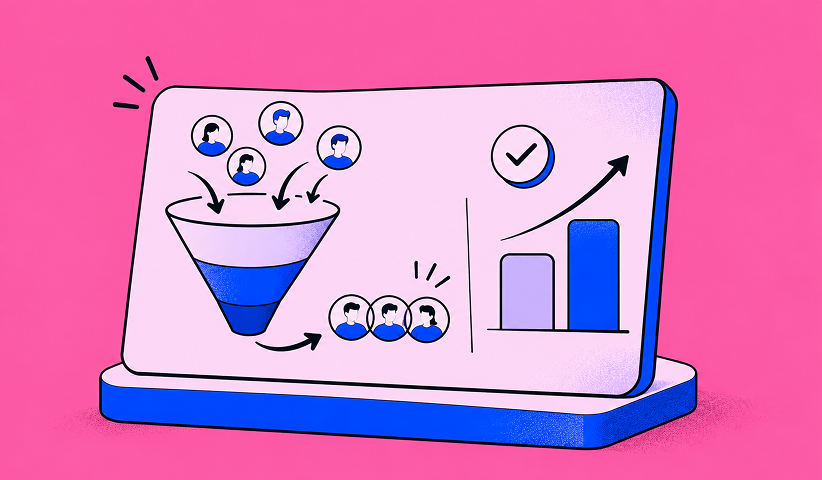
Some teams add a stage between the two: the SAL, or sales accepted lead. It is an MQL that sales has acknowledged and agreed to work. It acts as a checkpoint, so marketing cannot simply push leads over the wall and sales cannot let them sit untouched.
The sequence then reads: MQL, SAL (sales accepts and works it), SQL (need, access and agreement to discuss a solution are confirmed), opportunity. If your teams argue about lead quality, a SAL stage with a clear accept-or-reject rule often settles it.
The handoff is where leads die
The moment ownership changes from marketing to sales is the riskiest point in the funnel. Lead Advisors’ Neil Sampang calls it exactly that and says a strong handoff needs a clear MQL definition, a clear SQL definition and an enforced service level agreement (SLA). The same pattern shows up wherever marketing and sales operate on different assumptions: marketing counts MQLs, sales counts revenue, and the lead falls between them.
Speed is part of it. Response-time studies compiled by sales-data vendors suggest that inbound leads contacted within an hour convert at far higher rates than those contacted a day later. Treat those figures as directional and measure your own response times.
A handoff agreement that works
Put these rules in a one-page document that both the CMO and the head of sales sign:
- Entry rule: Document the precise MQL trigger, mandatory CRM fields and exclusions before a record enters the sales queue.
- Assignment: Specify routing by account ownership, territory or segment, with a fallback queue for unassigned records.
- Response SLA: Set working-hour acknowledgement and first-contact targets appropriate to lead urgency; measure actual response time rather than assuming an industry benchmark.
- Accept or reject: Sales records SAL acceptance or a coded rejection reason, including poor fit, duplicate, bad data, no intent or wrong timing.
- Recycling: Define when an unready lead returns to marketing, how its history is preserved and what behavior can qualify it again.
- Feedback loop: Review accepted leads, SQL creation, opportunities and closed revenue by source with marketing and sales weekly.
- Escalation: Assign an owner for overdue leads, missed SLAs and disagreement about qualification criteria.
Our GA4 B2B tracking guide shows how to connect CRM stages to revenue, which is what makes the weekly feedback loop possible.
How to read your MQL-to-SQL conversion rate
The formula is simple: SQLs created in a period divided by MQLs created in the same period (or, more accurately, by the cohort of MQLs from a given month, since leads take time to convert). If 400 MQLs produce 120 SQLs, your rate is 30%.
Published benchmarks vary widely by industry, sales cycle and how strictly MQLs are defined, so use them as a sanity check, not a target. SyncGTM’s guide suggests a useful rule of thumb: if conversion falls below 10%, tighten the MQL definition, and if it climbs above 30%, you may be setting the bar too high and starving sales of volume.
The diagnosis matters more than the number:
- Low conversion with high MQL volume: Audit the scoring threshold, audience fit, form incentives and lead sources before buying more traffic.
- Healthy acceptance but weak SQL conversion: Review sales outreach speed, discovery quality and whether the offer sets the right expectations.
- High SQL conversion with too few leads: Check whether MQL thresholds are excluding viable accounts and whether sales has enough pipeline.
- Channel variation: Compare matched acquisition cohorts rather than mixing leads of different ages; attribute SQLs back to the MQL cohort that produced them.
- Falling conversion over time: Investigate product, territory, sales capacity and CRM stage-definition changes before treating the decline as a marketing-only problem.
Break the rate down by source. Referrals and organic search tend to convert better than cold outbound email, which tells you where to invest. Our B2B marketing strategies guide and B2B marketing trends piece go deeper on channel mix.
Want to learn more about Digital Marketing and Strategy? Keep reading!
If you need help with your company’s marketing, contact us for a free custom quote.
When the MQL and SQL model strains

The MQL-to-SQL model assumes one person moves through a funnel. Modern B2B buying often does not work that way. Gartner research summarized by Konica Minolta describes buying groups of 6 to 10 decision-makers who gather information independently, with buying tasks such as problem identification, supplier selection and consensus creation happening more or less at once rather than in order. The same post reports that a large majority of buyers prefer a sales experience without a rep for much of the journey.
For a CMO, the consequence is practical:
- Add account context: Combine engagement from multiple contacts at the same company instead of scoring each contact in isolation.
- Recognize buying-group roles: Track champions, evaluators, budget owners and blockers where the data is available.
- Create a direct sales route for explicit hand-raises: A demo request from a qualified account should not wait for an arbitrary content score.
- Keep lifecycle rules transparent: Define when account intent complements, rather than replaces, individual MQL and SQL stages.
- Measure opportunity creation and revenue: Avoid optimizing solely for individual lead counts when deals require several stakeholders.
Our perspective
Most MQL and SQL problems we see are not lead problems. They are definition problems that show up as lead problems. When marketing optimizes for volume and sales optimizes for closed revenue, both teams can be right and the company still loses.
We build growth around what we call brand-backed performance: the brand makes the right buyers recognize you, and the performance engine turns that recognition into traceable pipeline. When the positioning is sharp, the MQLs that arrive already fit your ICP, and fewer of them die at the handoff.
Our advice to growth-stage leadership teams is to start with the written agreement, then connect tracking so every stage is visible from first touch to revenue, then invest in the channels that produce SQLs, not just MQLs. Paid media, content, conversion rate optimization and retention marketing all work better when everyone measures against the same definitions.
- Quincy Samycia
Turning clear definitions into pipeline
Once MQL and SQL are defined, the work is making each stage produce more of the right leads. That is where our integrated approach applies: paid media management from $5,500 per month, growth strategy from $8,500 per month, and content marketing from $5,500 per month, alongside branding, web and retention work for companies that want the funnel, the creative and the tracking built as one system.
If you want your qualification rules, landing pages, ad targeting and CRM stages aligned, see our services and pricing or start from brandedagency.com.
Frequently Asked Questions

What does MQL vs SQL mean in simple terms?
An MQL is a lead that marketing considers interested and a good fit, but not yet ready to talk to sales. An SQL is a lead that sales has vetted and confirmed is ready for a sales conversation. The first is a judgment from behavior and fit, the second a judgment from a conversation.
What is a good MQL-to-SQL conversion rate?
It depends on your industry, sales cycle and MQL definition, so there is no universal number. A common rule of thumb is to review your definition if the rate drops below about 10% or climbs above about 30%. Track it by lead source and by monthly cohort to see what is really driving it.
Who is responsible for an MQL and an SQL?
Marketing owns MQLs and nurtures them until they meet the agreed threshold. Sales owns SQLs and moves them toward an opportunity. A SAL stage, where sales formally accepts a lead, makes the transition explicit and prevents leads from stalling.
What is the difference between an SQL and a SAL?
A SAL is an MQL that sales has accepted and agreed to work. An SQL goes further: need, access to a relevant stakeholder and willingness to discuss a solution are confirmed. Not every company uses a SAL, but it helps when the two teams disagree on lead quality.
Do MQLs and SQLs still matter if buyers self-serve?
Yes, but the unit shifts. Buyers do much of their research digitally and in groups, so many teams score accounts and treat strong intent signals, such as a pricing-page visit or consultation request, as direct routes to sales. The definitions stay useful as shared language between marketing and sales.
Sources

Quincy Samycia
As entrepreneurs, they’ve built and scaled their own ventures from zero to millions. They’ve been in the trenches, navigating the chaos of high-growth phases, making the hard calls, and learning firsthand what actually moves the needle. That’s what makes us different—we don’t just “consult,” we know what it takes because we’ve done it ourselves.
Want to learn more about brand platform?
If you need help with your companies brand strategy and identity, contact us for a free custom quote.
We do great work. And get great results.
+2.3xIncrease in revenue YoY
+126%Increase in repurchase rate YoY




+93%Revenue growth in first 90 days
+144% Increase in attributed revenue




+91%Increase in conversion rate
+46%Increase in AOV




+200%Increase in conversion rate
+688%Increase in attributed revenue