SMS Marketing for Ecommerce: The 2026 Playbook to Drive Sales and Loyalty
07/23/2026
Marketing Strategy / E-Commerce

.png)


How SMS Marketing Supports Ecommerce Growth


SMS marketing helps ecommerce brands deliver concise messages at relevant moments in the customer journey. A text might announce a product launch, deliver a requested stock alert, or remind an eligible shopper about an unfinished checkout.
Its effectiveness depends on whether the message is useful, expected, and easy to act on. This guide explains how to plan SMS campaigns, coordinate them with other channels, and evaluate their contribution to sales and customer retention.
Key Takeaways
- Start with clear SMS preferences. An email subscription or phone number supplied for delivery should not automatically become permission for promotional texts.
- Separate message types. Marketing campaigns, order updates, and support conversations serve different purposes and require appropriate eligibility rules.
- Measure delivery, interaction, and purchases separately. A delivered text does not prove someone read it, and a click does not establish a sale.
- Coordinate email and SMS. Use shared purchase data and exclusions to prevent duplicate reminders and messages sent after someone has ordered.
- Account for actual sending costs. Depending on the provider, destination, and message format, one visible text may consume multiple billable segments or credits.
- Distinguish attributed revenue from incremental results. Platform-reported sales do not establish how much additional revenue SMS caused.
- Review timing rules by market. Quiet-hour settings, consent requirements, and opt-out handling need to reflect the applicable jurisdiction and platform configuration.
What Is SMS Marketing for Ecommerce?
SMS marketing for ecommerce is the use of promotional text messages to share relevant offers, product announcements, and purchase opportunities with eligible subscribers. SMS stands for Short Message Service.
A broader ecommerce texting program may also include transactional messages, such as shipping updates, and two-way customer support where the platform supports replies.
Keep these purposes distinct. Someone requesting delivery updates has different expectations from someone subscribing to promotional offers. A service message should not acquire a sales pitch without the appropriate marketing eligibility.
SMS complements ecommerce email marketing. Email provides space for detailed explanations, product comparisons, and educational content. SMS can communicate a short update with a clear next step.
Why SMS Open-Rate Claims Need Caution
Standard SMS does not provide a reliable open-tracking metric showing whether a recipient read a message. A delivery confirmation is a technical status, not a read receipt.
Claims that SMS achieves a universal 98% open rate should therefore not be treated as a campaign benchmark. Klaviyo’s SMS metrics guidance describes the delivery, click, and other events available for reporting.
Evaluate your program using observable actions and business outcomes rather than assuming every delivered message receives attention.
When SMS Makes Sense for an Ecommerce Brand
SMS is worth considering when the customer has chosen the channel and a concise message helps them act on something relevant.
Examples include:
- Product launches: Notify interested subscribers when a confirmed release becomes available.
- Requested stock alerts: Tell shoppers when an item they asked about is back.
- Eligible checkout reminders: Provide a route back to an unfinished purchase, with checks that stop messages after an order.
- Relevant offers: Explain a promotion suited to the recipient’s interests or purchase history.
- Order communication: Provide service updates under the appropriate permissions, separately from promotional campaigns.
A message does not need manufactured urgency to be useful. Refer to deadlines, limited stock, or exclusive access only when those conditions are accurate.
What Supports Engagement and Conversion?
Relevance begins with audience selection. A previous purchaser, a new SMS subscriber, and someone awaiting a stock alert may each need different content.
Before sending, check:
- Does the recipient qualify for this specific message?
- Is the product or offer relevant and available?
- Does the link lead to the correct destination?
- Are pricing and promotional terms consistent with the website?
- Has the shopper already purchased?
- Have they recently received related email or SMS messages?
- Is the send time appropriate for their location?
The mobile shopping experience also matters. A useful text can still lead to a failed purchase if the landing page is confusing, the discount does not work, or checkout is difficult.
There is no universal requirement to send two or three abandonment texts. Start with a defined purpose and assess purchases, costs, and opt-outs before adding further reminders.
How SMS Fits With Other Marketing Channels
Plan email and SMS around the same customer journey while maintaining separate channel preferences.
For example:
- Use email for a detailed product introduction and SMS for a relevant launch update to eligible text subscribers.
- Direct interested visitors from social media or advertising to a clearly explained SMS signup form.
- Coordinate checkout reminders so customers do not receive overlapping messages with the same request.
- Stop recovery messages across channels when a purchase is recorded.
- Offer subscribers a choice of communication channels where your setup supports it.
Our guide to email flows for Shopify stores explains welcome, abandonment, and winback journeys, including eligibility, purchase exclusions, and coordination with SMS.
Avoid using an email open alone as the reason to send a text. Check SMS eligibility, purchase activity, and whether another message would provide useful information.
Before configuring automation, verify which events your ecommerce integration actually supplies. Test order updates, subscription status, and purchase exclusions rather than assuming every connected system stays synchronized.
ROI and Revenue Contribution
SMS profitability depends on product margins, audience response, messaging costs, discounts, and management effort. A platform’s attributed-revenue figure alone does not establish return on investment.
Understand the billing model before forecasting costs. SMS messages can be divided into multiple segments, and some providers use credits that vary by country or message type. Message length and encoding—including some special characters—can affect the charge. See Klaviyo’s messaging system guidance for a platform-specific explanation.
Include applicable platform fees, sending charges, creative production, campaign management, and promotional costs when evaluating results.
Hypothetical example: An apparel brand wants to test whether a promotional text generates additional purchases. It randomly assigns eligible subscribers to receive the message or join a holdout group, while keeping other marketing treatment comparable. It then compares purchases and contribution margin over a predefined period.
With sufficient data and a suitable test design, this can help estimate the additional effect of the text. It does not assume that every sale credited to SMS would otherwise have been lost.
The SMS Metrics That Matter
Keep these measures separate and define the reporting period:
- Delivery rate: Messages reported delivered divided by messages sent, multiplied by 100. Document how the platform counts sends and failures.
- Unique click-through rate: Unique recipients who click a tracked link divided by delivered recipients, multiplied by 100.
- Attributed orders and revenue: Purchases credited to SMS under the platform’s attribution settings and conversion window.
- Attributed revenue per delivered recipient: Revenue credited to the campaign divided by its delivered recipients.
- Opt-out rate: Unique recipients who unsubscribe divided by a clearly stated recipient denominator, applied consistently across campaigns.
- Campaign cost: The platform, messaging, production, and management costs allocated to the activity.
- Incremental impact: The estimated additional purchases or contribution margin compared with what would have happened without the campaign.
For ROI, compare incremental contribution before campaign costs against those costs. If you only have attribution data, label the result accordingly rather than presenting it as proven incremental return.
Use these findings within your broader retention marketing strategy to decide which messages are useful, which are profitable, and which should be changed or stopped.

Free Brand Health Audit
Make sure your brand is built to sell

Core SMS Campaign Types for Ecommerce Stores


Want to learn more about Website Design, Development and E-commerce? Keep reading!
Designing an Ecommerce SMS Marketing Strategy

Compliance, Deliverability, and Respecting Subscriber Trust

A reliable ecommerce SMS program depends on clear permission, recognizable messages, appropriate timing, and secure handling of customer information. Build these requirements into signup forms, campaigns, automations, and customer support processes.
Consent, Opt-Outs, and Quiet Hours
Build promotional SMS around a clear, separate opt-in. Explain which brand will send messages, what subscribers can expect, and how they can unsubscribe. Keep consent language visible and optional checkboxes unchecked.
Email consent and a phone number provided for delivery do not automatically establish permission for promotional SMS. Maintain separate records for marketing permission and order-related messaging.
Your consent records should include:
- The phone number and brand covered by the permission.
- The signup source, date, and time.
- The exact disclosure shown when the person subscribed.
- The message categories they agreed to receive.
- Confirmation records, where applicable.
- Subsequent preference changes and opt-out requests.
Provide an unsubscribe method that works with your sender type. Reply-capable numbers can support STOP requests; one-way branded sender IDs need another method, such as an unsubscribe link. Klaviyo explains these SMS opt-out options.
Configure suppression to take effect as soon as an opt-out arrives. Honor other clear requests to stop, and synchronize suppression records across connected systems so an import or automation cannot accidentally restart messages.
Apply quiet hours according to the recipient’s applicable requirements. Review Klaviyo’s quiet-hours guidance when configuring flows, while recognizing that platform defaults are not universal legal rules.
Deliverability, Sender IDs, and Number Types
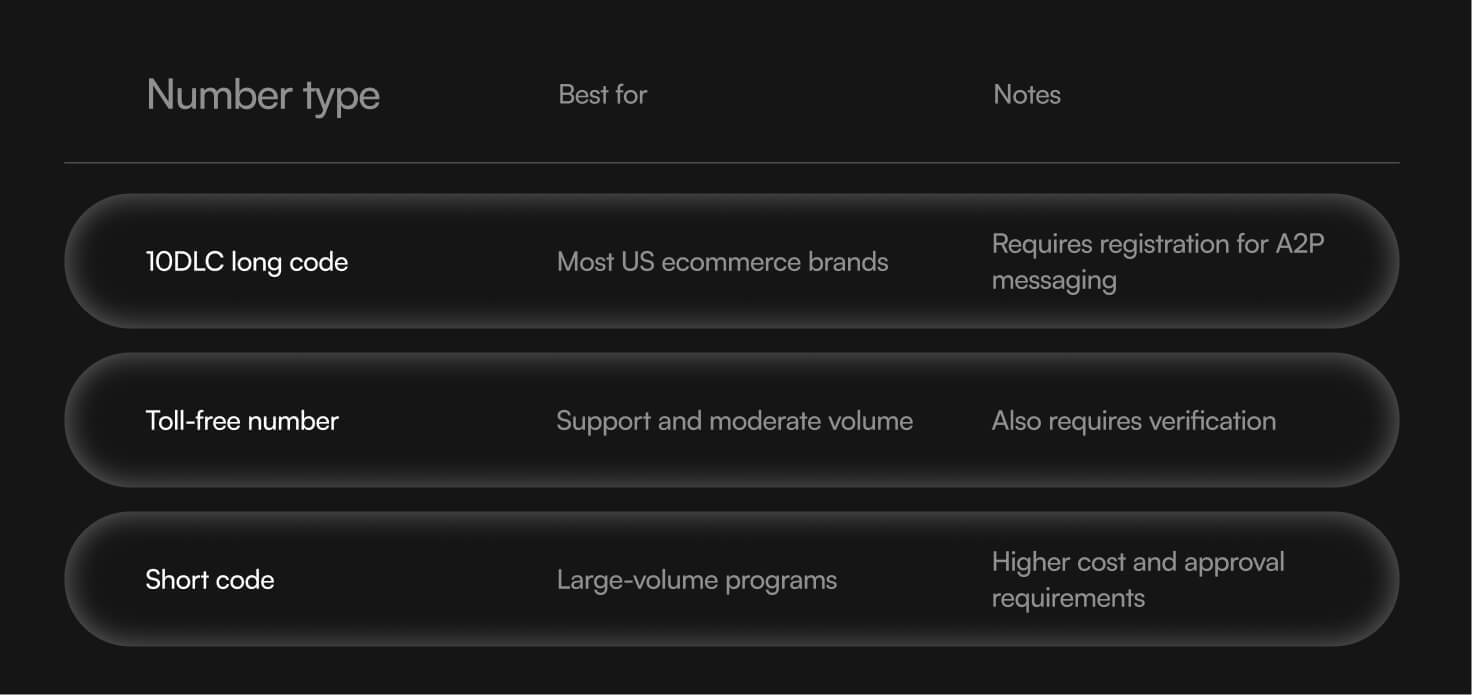
Your sending number affects registration requirements, delivery capacity, reply handling, and geographic availability.
Common options include:
- 10-digit long codes: Local-format numbers. Business messaging to U.S. recipients through these numbers generally requires A2P 10DLC brand and campaign registration. See Twilio’s A2P 10DLC guidance.
- Toll-free numbers: A separate sending option with its own verification process. Follow your provider’s requirements, such as Twilio’s toll-free verification process.
- Short codes: Short numeric senders that require a separate application and approval process.
- Alphanumeric sender IDs: Brand names displayed as the sender in supported markets. These can be one-way, which changes how customers contact you and unsubscribe.
Choose a sender based on destination countries, expected volume, and support needs. Registration does not replace subscriber permission or guarantee delivery.
Identify your brand clearly in messages. Monitor delivery failures, carrier filtering, opt-outs, and complaints, and investigate sudden changes before increasing volume.
Data Security and Regional Regulations
Limit access to subscriber information to people who need it. Use multifactor authentication, appropriate access permissions, secure integrations, and documented retention periods. Review providers’ security practices, data-processing terms, and international data-transfer arrangements where relevant.
Keep the minimum suppression information needed to honor opt-outs, with a documented purpose and retention policy.
Regional overview reviewed September 23, 2026:
- United States: Covered automated marketing texts require prior express written consent under federal TCPA rules. Covered telephone solicitations are restricted before 8 a.m. and after 9 p.m. at the recipient’s location. Additional state requirements may apply. Review 47 CFR § 64.1200.
- Canada: CASL generally requires consent, sender identification, and an unsubscribe mechanism for commercial electronic messages. Express and implied consent have different conditions; implied consent can expire. Consult the CRTC’s Canadian consent guidance.
- United Kingdom: Marketing texts to individuals generally require specific consent unless the limited customer “soft opt-in” applies. That exception has conditions, including an opportunity to opt out when details are collected and in subsequent messages. See the ICO’s electronic marketing guidance.
- European Union: GDPR governs personal-data processing, while national laws implementing the ePrivacy Directive govern electronic marketing permissions. A GDPR lawful basis alone does not resolve permission to send promotional texts. Review the European Commission’s data-protection guidance and ePrivacy rules on unsolicited communications.
- California: Businesses covered by the CCPA must address applicable privacy notices, consumer rights, and data practices. These obligations are separate from SMS marketing consent. Check the California Attorney General’s CCPA guidance.
Review these requirements when entering a new market or changing your messaging program. Your provider’s policies and carrier requirements may be stricter than the legal minimum.
Measuring and Optimizing Your Ecommerce SMS Program
Measure SMS across four areas: delivery, engagement, attributed sales, and incremental business results. Each answers a different question about performance.
Review operational issues after sends and evaluate business outcomes once the relevant purchase window has passed.
Key Metrics for SMS Marketing Success
Use consistent definitions so campaign comparisons remain meaningful:
- Delivery rate: Messages reported as delivered divided by messages sent. Delivery does not establish that someone read the message.
- Click-through rate: Unique recipients who clicked divided by delivered recipients for the campaign.
- Attributed purchase rate: Unique recipients credited with a purchase divided by delivered recipients, using a documented attribution window.
- Opt-out rate: Campaign-associated unsubscribes divided by delivered recipients.
- Revenue per delivered message: Attributed revenue divided by delivered messages.
- Revenue per 1,000 delivered messages: Revenue per delivered message multiplied by 1,000.
- Net list growth: New marketable subscribers minus subscribers removed from the marketable list during the period.
- Subscriber churn: The share of your starting marketable audience lost during the reporting period.
- Support performance: Reply volume, response time, and unresolved customer requests.
Calculate message-performance metrics using recipient messages, keeping billable SMS segments separate. Document how your reporting handles refunds, discounts, taxes, and shipping revenue.
High click-through rates with few purchases warrant a review of the offer, landing page, checkout, and tracking setup. A spike in opt-outs warrants checking audience relevance, frequency, consent expectations, and timing.
Compare results within similar audiences. VIP customers and new subscribers have different purchase histories and should not be expected to behave identically.
Attribution and Multi-Channel Impact
Attribution assigns credit for a sale according to reporting rules. Incrementality estimates whether sending SMS caused additional sales.
Use consistent campaign names and UTM parameters to identify traffic. Then document:
- Which interactions qualify for attribution, such as clicks or deliveries.
- How long the attribution window remains open.
- How competing email, SMS, and other channel interactions are handled.
- Whether the report uses order dates or message-send dates.
- How refunds and cancellations affect reported revenue.
There is no universal 24–72-hour attribution window that suits every ecommerce store. Choose settings that reflect your buying cycle and reporting purpose, and keep them consistent when evaluating changes. Review Klaviyo’s attribution documentation to understand how its settings affect results.
Avoid adding revenue claimed by separate marketing platforms without checking for overlapping orders.
To test whether SMS adds value to an existing email program, randomly divide customers eligible for both channels into two groups:
- One group receives the planned email campaign.
- The other receives the same email campaign plus SMS.
Keep other treatment consistent and compare purchases and contribution margin per person assigned to each group over the same period. Continue necessary service messages for both groups.
Comparing people who clicked SMS with email-only subscribers does not establish incremental impact; those audiences may already differ in purchase intent.
Iterating on Strategy Over Time
Use a monthly review to identify changes worth testing:
- Which flows produce sufficient margin after messaging costs?
- Where are opt-outs or delivery failures increasing?
- Are campaigns and automations contacting the same customers too frequently?
- Do purchase and unsubscribe events reliably stop inappropriate follow-ups?
- Which customer questions reveal missing product information?
- Are results consistent across countries, customer stages, and product categories?
Prioritize one meaningful change at a time. Keep a record of the audience, change, measurement window, cost, and outcome.
Connect these findings to your broader retention marketing strategy, including email, customer support, and the post-purchase experience.
FAQ: SMS Marketing for Ecommerce
How many SMS messages should my ecommerce store send per month?
There is no universal ideal frequency. Set a schedule that matches the expectations established at signup, your product’s purchase cycle, and the usefulness of each message.
Count campaigns and automated marketing texts together when reviewing frequency for an individual subscriber. Evaluate service notifications separately.
As a hypothetical starting point, a store could test two promotional campaigns in a month alongside carefully limited flows. Adjust based on purchases, margin, opt-outs, and customer feedback.
Is SMS marketing useful if I already have strong email campaigns?
SMS can complement an established email program when it adds a relevant, timely touchpoint.
Use your ecommerce email marketing strategy for detailed education and ongoing communication, then select specific moments where subscribers would benefit from a text.
Coordinate offers and sending schedules, confirm permission for each channel, and test email-only against email-plus-SMS groups to estimate the additional contribution.
Can I use SMS marketing for international customers?
Yes, where your provider supports the destination and your program meets the applicable requirements.
Review consent, sender registration, permitted content, quiet hours, unsubscribe methods, language, and pricing for each market. Confirm whether the sending number supports replies.
A phone number’s country code does not necessarily establish the customer’s current location or time zone. Account for that uncertainty when configuring sending windows.
What budget should I plan for ecommerce SMS marketing in 2026?
Build the budget from expected usage and current provider rates.
Include:
- Platform subscriptions or minimum monthly commitments.
- Campaign and automated-flow volume.
- Billable SMS segments and MMS charges.
- Destination-specific rates.
- Number rental, registration, or verification fees where applicable.
- Carrier charges where they are not already included.
- Strategy, creative, integration, and customer support time.
Hypothetical volume example: Sending three campaigns to 2,000 recipients, with each message using two segments, produces 12,000 SMS segments before automated flows.
Calculate costs using the applicable rate for each destination and sender type. Klaviyo’s mobile messaging billing guide explains segment-based calculations and its rate structure.
Set spending limits and alerts. Assess profitability after discounts, returns, product costs, fulfillment, and SMS program expenses; attributed revenue divided by messaging fees alone is not a complete ROI calculation.
How should my ecommerce store handle customer support replies by SMS?
Choose a reply-capable sender and route conversations into a monitored inbox or helpdesk. Publish support hours and set a realistic response-time expectation.
Use automated acknowledgments to confirm receipt and explain when help is available. Route complex issues to a person with the relevant order context, and move sensitive account information to an appropriate secure support channel.
Process unsubscribe requests automatically without making customers wait for a support agent. Keep HELP requests separate from opt-outs, and regularly test both processes.

Quincy Samycia
Want to learn more about brand platform?