Stop Wasting a Budget Cycle: Tech Brand Strategy for Growth Stage
11/03/2026
Brand Strategy
Growth stage playbook: craft a five-layer positioning brief, track branded search and win rates, align execution to close enterprise deals.

Your first priority is a stage-matched positioning claim, falsifiable and backed by customer outcomes, not a slogan or a vague mission statement. Pair it with the credibility infrastructure that lets buyers verify the claim without calling your sales team. The five-layer positioning framework gives you the discipline to write that claim correctly, and firms like The Branded Agency exist precisely to turn it into a working go-to-market system.


What Does “Tech Brand Strategy” Actually Mean?



Tech brand strategy is the discipline of aligning how a technology company positions itself, talks about its product, looks across every touchpoint, and proves its claims to a buying committee that includes technical evaluators, economic buyers, and end users. It is not a logo project. It is not a rebrand for its own sake. It is the operating system behind every message your sales team sends and every page your website renders.
The scope differs from consumer branding and generic B2B branding in one critical way: technical buyers evaluate claims, not feelings. A consumer brand can win on emotional resonance alone. A tech brand has to earn trust through proof, because the purchase carries career risk for the person signing off on it. That changes what “branding” has to deliver.
A complete tech brand strategy engagement typically produces:
• Positioning and category definition. A defensible statement of the market you serve, the costly problem you solve, and the alternatives buyers compare you against.
• Buyer and competitive messaging. A message hierarchy for technical evaluators, economic sponsors, and end users, supported by a competitor claim audit.
• Credibility infrastructure. Proof assets such as customer case studies, security and compliance documentation, product demonstrations, and independent reviews.
• Identity and experience principles. A recognizable verbal and visual system applied consistently to the site, product, sales decks, and onboarding.
• Activation and measurement plan. Named owners, a rollout roadmap, and a scorecard tracking buyer confidence, qualified pipeline, win rate, and adoption.
If your current “brand work” stops at a new logo and color palette, you have a design refresh, not a brand positioning strategy. The two get confused constantly, and the confusion costs companies a full budget cycle before anyone notices the actual gap.
Why Do Tech Companies Need a Different Branding Approach?
Technology products are intangible and change fast, which breaks the assumptions most branding frameworks are built on. A consumer packaged good looks the same on the shelf for years. A SaaS platform can ship three feature releases before a rebrand even launches. Your brand strategy has to be durable enough to survive that pace without becoming a liability the moment the roadmap shifts.
The buying committee problem compounds this. Enterprise software purchases rarely involve one decision maker. They involve a technical evaluator who cares about architecture, an economic buyer who cares about total cost of ownership, and an end user who cares about whether the tool makes their day easier. Every one of them is taking on career risk by recommending you. Forrester’s research on business buying confirms that buyer expectations for vendor credibility and differentiation have only intensified as B2B purchasing has grown more complex.
Brand strategy reduces friction at exactly the point where deals stall:
• Early research. Clear category language helps buyers understand the offer without first needing a sales explanation.
• Technical validation. Architecture diagrams, product documentation, integrations, and security answers let evaluators investigate independently.
• Business approval. Outcome-backed case studies and cost-of-inaction framing help sponsors build an internal business case.
• Implementation and renewal. A product experience consistent with the promise reduces surprises after the deal and supports expansion.
Buyers increasingly lean on verified social proof before they ever talk to sales. G2’s buyer behavior research documents how reputation signals, reviews, and third-party validation now shape vendor evaluation earlier in the funnel than most marketing teams assume. Skip that infrastructure and you are asking your sales team to build trust from zero on every single call.
What Are the Core Components of an Effective Tech Brand Strategy?
Five modules make up a working tech brand strategy. Skip one and the whole system gets wobbly, usually right when a big deal is on the line.
• 1. Positioning. Define the category, target accounts, buyer problem, current alternatives, and one specific claim that can be tested.
• 2. Messaging. Translate the core claim into role-specific proof and language for IT, finance, operational users, and procurement.
• 3. Visual and verbal identity. Use a coherent system of design, voice, and terminology that makes complexity easier to understand.
• 4. Credibility. Publish verifiable outcomes, customer evidence, implementation details, and relevant security information instead of unsupported superlatives.
• 5. Activation. Apply the strategy across the website, product, sales enablement, customer communications, and campaigns, with owners and KPIs.
Pro Tip: Write your positioning claim as a sentence a competitor’s product literally cannot make. If any rival could swap in their own name and the sentence still reads true, the claim is not specific enough to survive a bake off.
Product experience deserves its own line here. UX is not a downstream design task. It is where the brand promise either gets confirmed or quietly broken. The Interaction Design Foundation’s guidance on UX design makes the case that usable, well-designed product experiences transform complex features into something buyers actually trust, and early product touchpoints often determine whether an enterprise evaluator proceeds to technical review at all.
Free Brand Health Audit
Make sure your brand is built to sell
Search has changed. Your customers aren't just Googling anymore. They're asking ChatGPT, Perplexity, Gemini and other AI platforms what to buy, who to trust and which brands they should consider.
If your brand isn't showing up clearly in those answers, you're already losing opportunities. Our free Brand Health Audit shows you where your brand stands across traditional search, AI search and brand positioning.

Sample brand audit
Live preview
Traditional search
72
AI search (GEO)
34
Brand positioning
58
How Should Branding Priorities Shift by Company Stage?



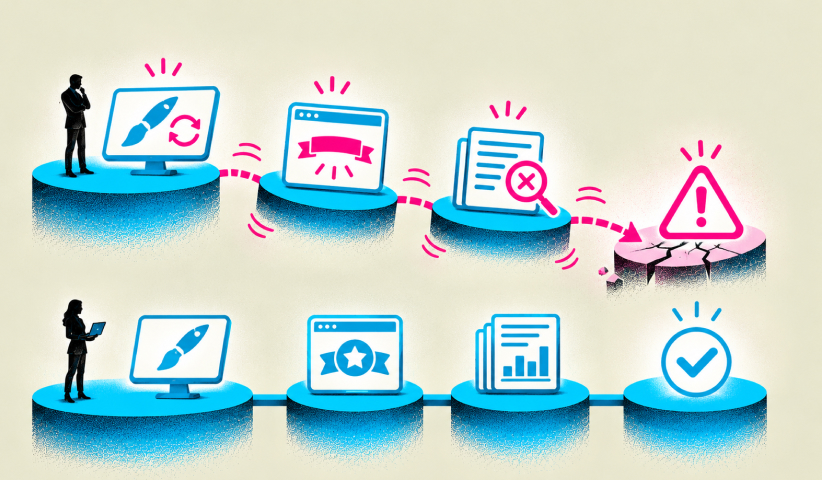
A seed-stage positioning exercise and an enterprise governance rollout are not the same project wearing different clothes. Applying an enterprise-level brand system to a five-person startup wastes the budget the company needs for product development. Applying seed-stage informality to an enterprise sales motion undermines the exact credibility that motion depends on. Stage-calibrated audits exist to prevent that mismatch, and they specify genuinely different implementation horizons for each stage.
Seed stage priorities center on speed and clarity, not polish:
• Primary objective. Test whether a narrow audience recognizes the problem and understands your differentiated claim.
• Minimum outputs. A one-page positioning brief, short buyer interview summary, simple site narrative, and reusable pitch deck.
• Success signal. Prospects can explain the product back accurately and take the next meaningful evaluation step.
Growth stage shifts the emphasis toward proof and repeatability:
• Primary objective. Make the positioning credible and consistent as the team, customer base, and acquisition channels expand.
• Priority outputs. Segment messaging, case studies, review strategy, competitive sales materials, and a governed visual system.
• Success signal. Higher qualified-opportunity conversion, better competitive win rates, and more consistent sales adoption of the message.
Enterprise stage is about governance and consistency at scale:
• Primary objective. Keep product lines, regional teams, and buyer segments aligned without slowing delivery.
• Priority outputs. Brand architecture, approved messaging library, design system, review workflows, and regional or regulated-market adaptations.
• Success signal. Fewer inconsistent claims, more efficient approvals, and strong performance across products and regions.
If your company sells into government or dual-use markets, the trust signals change again. Procurement evaluation criteria under FAR 15.304 reward different proof points than commercial buyers do, and a company like a defense contractor operating under federal budget frameworks has to separate commercial messaging from government-facing messaging entirely. That is a narrow case, but it is a costly mistake for the companies it applies to.
The signal for how deep your audit needs to go is usually organizational: who has authority to approve the work, and what implementation horizon they are planning against. A founder who can greenlight changes in a week needs a lighter audit than a VP navigating a multi-quarter enterprise rollout.
What Is the Step-by-Step Branding Process?
The process itself does not need to be complicated. It needs to be sequenced correctly, because skipping ahead is where most projects go sideways.
• Step 1: Audit reality. Interview sales, product, customer success, customers, and lost prospects; review competitive claims and existing assets.
• Step 2: Define the buyer problem. Document the buying committee, their objections, triggers, and actual alternatives.
• Step 3: Draft the positioning claim. Write a specific statement linking category, audience, problem, differentiation, and verifiable outcome.
• Step 4: Pressure-test the claim. Test language in customer interviews and sales conversations; remove claims that buyers cannot understand or verify.
• Step 5: Build the proof system. Match each important claim with demos, case studies, product evidence, security resources, or credible third-party validation.
• Step 6: Activate and govern. Update the website, sales deck, product touchpoints, and campaigns; assign an owner and review performance quarterly.
Pro Tip: Pilot your new positioning language in outbound sales emails before you touch the website. Sales gets a faster feedback loop, and a claim that falls flat on a cold email will fall flat on a landing page too, just slower and more expensively.
Following a structured brand strategy process keeps the sequence honest. Teams that jump straight to creative production without the audit and brief almost always end up rewriting the creative six months later.
How Do You Measure Whether a Brand Strategy Is Working?
Brand work earns budget when it moves numbers a CFO recognizes, not just numbers a marketing team likes. The leading indicators worth tracking week to week are branded search volume, win rates against named competitors, and the quality of inbound pipeline, meaning how many inbound leads convert to qualified opportunities without extensive nurturing. Forrester’s business buying research treats branded search and win rate as strong, tractable signals precisely because marketing teams can influence both directly through positioning and content work.
Beyond those leading indicators, a small set of operational KPIs shows whether brand investment is translating into business results.
• Leading indicators: Track branded search volume, win rate versus named competitors, and inbound lead quality. These show whether positioning is resonating before revenue fully matures.
• Sales efficiency: Track sales cycle length and average deal size. These indicate whether the proposition is helping buyers evaluate and justify a purchase.
• Retention: Track net revenue retention and expansion rate. These help assess whether the experience delivers on the promise after the initial sale.
Build a quarterly dashboard around these three rows, and run one experiment per quarter tied to a single leading indicator. Buyer reliance on verified reputation signals, as G2’s research documents, means review volume and review quality belong on that dashboard too, especially for companies selling through a self-serve or product-led motion where buyers evaluate you before a rep ever gets on the phone.
What Are the Most Common Tech Branding Mistakes?
Most brand failures in tech companies trace back to a handful of repeatable errors, and every one of them is preventable with the right sequencing.
• Redesigning before positioning. Teams refresh colors and logos without fixing the unclear claim. Validate the strategy first.
• Writing for only one stakeholder. Technical buyers, finance approvers, and users require different evidence. Build a role-based messaging matrix.
• Claiming differentiation without proof. Generic promises about innovation or speed do not survive procurement. Tie claims to demonstrated capabilities and customer outcomes.
• Letting every channel invent a new story. Disconnected website, sales, and paid media copy weaken trust. Maintain one approved message hierarchy.
• Ignoring product experience. A polished website cannot compensate for an onboarding flow that contradicts the promise. Include UX in the brand audit.
• Skipping measurement and ownership. Without a baseline, named executive owner, and quarterly review, positioning drifts. Put governance into the rollout plan.
Every one of these is an execution failure, not a strategy failure. The frameworks exist. Teams just skip steps under deadline pressure.
Want to learn more about brand platforms, Brand Strategy and Brand Identity? Keep reading!
If you need help with your companies brand strategy and identity, contact us for a free custom quote.
How Does an Agency Approach a Tech Brand Strategy Engagement?
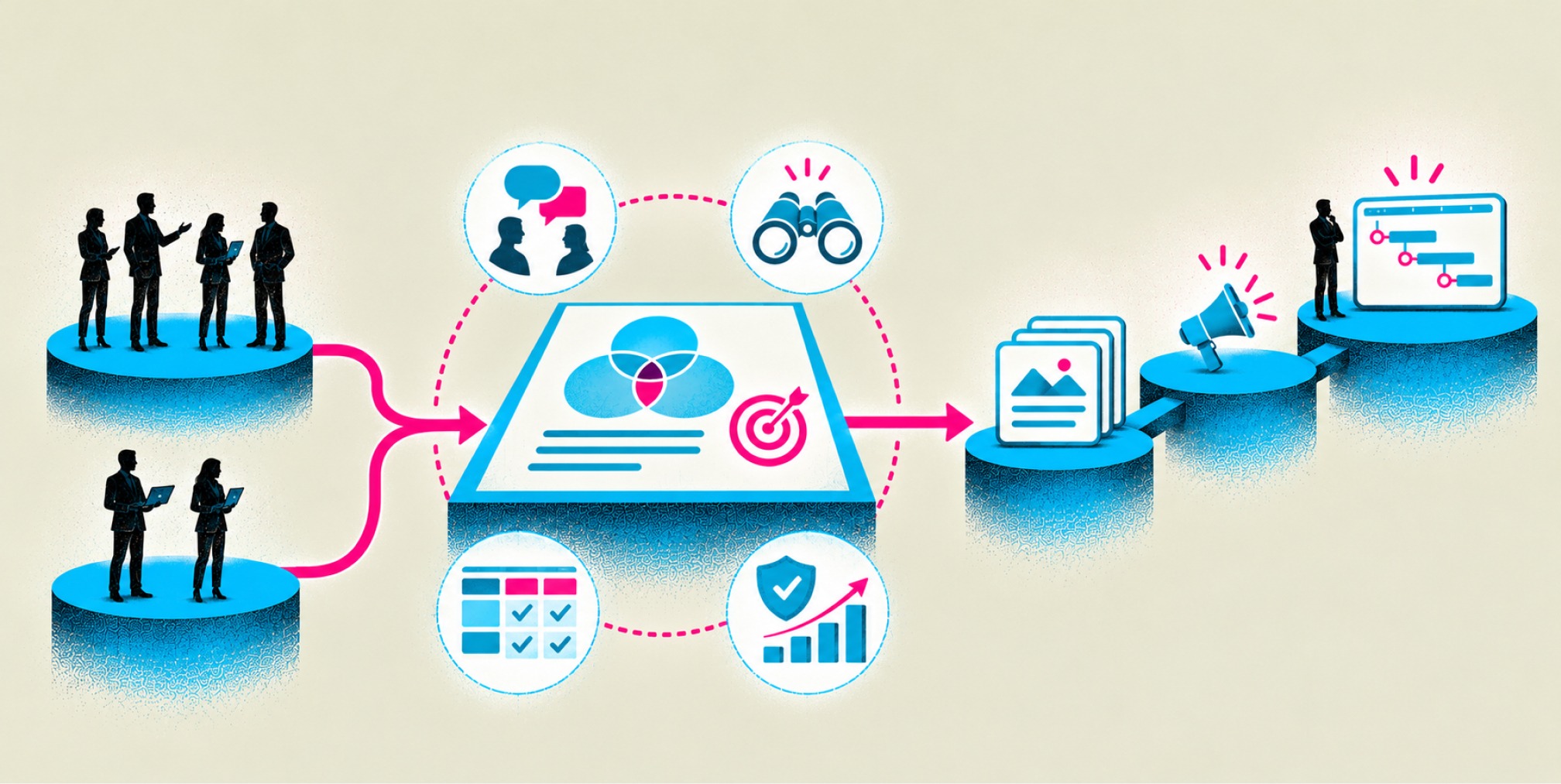
A structured positioning audit starts with stakeholder interviews across sales, product, and customer success, because the gap between what a company says and what its own team believes is usually where the real problem lives. From there, the work compresses into a one-page claim using the five-layer stack, tested against the top three competitive alternatives before it ever reaches a creative brief.
Typical deliverables from a positioning engagement include a competitive teardown, a messaging matrix mapped to buying-committee roles, and a credibility roadmap that sequences case studies and proof points against the sales team’s actual pipeline stages. The indicators that matter most at this stage are qualitative before they are quantitative: does sales adopt the new language without being told to, and does the claim survive a skeptical technical buyer’s first objection.
The single biggest credibility test for a new positioning claim is whether your own sales team starts using it unprompted within the first two weeks. If they quietly keep using the old pitch, the new one has not earned trust internally yet, and it will not earn trust externally either.
For in-house teams evaluating agency partners, the useful questions are practical: Does the agency show its audit methodology? Does it tie deliverables to indicators you can track, like the ones in a b2b brand strategy engagement? Does it stage the work by your company’s actual size, not a template it reuses for every client regardless of stage?
The Executive Trade-Offs Nobody Puts in the Deck
Brand investment and short-term performance marketing compete for the same budget line, and that tension never fully resolves. The honest answer is to fund brand ahead of a fundraise or a major market expansion, when the cost of an unclear positioning claim compounds across every deal in the pipeline. Funding it reactively, after win rates have already slipped, means paying for the same work at a worse price and a slower timeline.
Governance is the part leadership teams underrate. Positioning drifts the moment a new VP of Sales rewrites the pitch deck or a new hire in marketing “improves” the tagline without checking it against the original claim. A quarterly review, owned by one accountable executive, is the cheapest insurance against that drift. It costs an hour a quarter and it saves you from relaunching the same positioning work eighteen months from now.
Get the stage-matched claim right, back it with real credibility infrastructure, and govern it deliberately. That is the whole job.
Get Executive-Level Branding Built for Growth-Stage Companies
A full-service marketing agency can provide a single team to run the positioning audit, messaging architecture, visual system, and go-to-market rollout as a connected engagement, tied to leading indicators rather than disconnected deliverables.
This approach fits growth-stage tech companies and marketing leaders who need a claim that survives a skeptical enterprise buyer, not a rebrand that looks good in a launch email and says nothing three months later. Services may span branding through paid media and conversion optimization, helping to align positioning with performance campaigns.
If your positioning claim has not been stress-tested in the last year, start with an executive-level branding engagement and get a stage-matched audit scoped to where your company actually stands today.
Frequently Asked Questions

What Are the Five Pillars of Brand Strategy?
Most frameworks converge on positioning, messaging, visual identity, credibility infrastructure, and activation. For tech companies specifically, the five-layer positioning stack, naming category, audience, problem, alternatives, and claim, sits underneath all five as the foundation the rest depends on.
What Are the Seven Key Elements of a Brand Strategy?
Definitions vary across frameworks, but a common version expands the five pillars above by splitting messaging into voice and content strategy, and adding measurement as a distinct discipline. The core work, positioning, messaging, and proof, matters more than the exact count.
What Is the 3-7-27 Rule of Branding?
This is a popular claim about how many touchpoints it takes for a brand to register with a buyer, but it is not backed by a consistent, citable methodology. Treat it as a rule of thumb rather than a measured standard, and focus instead on tracking branded search and win rates, which are indicators you can actually verify.
What Are the 5 C’s of Branding?
Common versions include company, customers, competitors, collaborators, and climate (or context), used as a scan of the forces shaping a brand’s position. It functions as a situational audit checklist rather than a replacement for a structured positioning framework.
How Long Does a Tech Brand Strategy Engagement Take?
Timelines follow company stage: seed-stage audits can run one to two weeks, while enterprise audits with stakeholder interviews and governance mapping often take six to eight weeks before creative production even begins.
Sources
• Forrester: B2B buyer research and insights. https://www.forrester.com/b2b-marketing/
• G2: Software buyer insights and research. https://research.g2.com/
• Interaction Design Foundation: User experience design. https://www.interaction-design.org/literature/topics/ux-design
• Federal Acquisition Regulation: FAR 15.304, Evaluation factors and significant subfactors. https://www.acquisition.gov/far/15.304

Quincy Samycia
As entrepreneurs, they’ve built and scaled their own ventures from zero to millions. They’ve been in the trenches, navigating the chaos of high-growth phases, making the hard calls, and learning firsthand what actually moves the needle. That’s what makes us different—we don’t just “consult,” we know what it takes because we’ve done it ourselves.
Want to learn more about brand platform?
If you need help with your companies brand strategy and identity, contact us for a free custom quote.
We do great work. And get great results.
+2.3xIncrease in revenue YoY
+126%Increase in repurchase rate YoY




+93%Revenue growth in first 90 days
+144% Increase in attributed revenue




+91%Increase in conversion rate
+46%Increase in AOV




+200%Increase in conversion rate
+688%Increase in attributed revenue