Here’s A Complete Brand Strategy Development Framework You Can Steal
03/24/2025
Brand Strategy



What Is a Brand Strategy Framework?


Free Brand Health Audit
Make sure your brand is built to sell

Brand Strategy Example: From Positioning to Product Page


For Milton Coffee Co., the challenge was helping shoppers understand what made its coffee machine worth a premium price. That gave our team a specific question to answer during the Shopify redesign: What does a customer need to see before they’ll consider paying more?
That’s where brand strategy becomes useful. A headline like “Premium coffee at home” tells shoppers how you want them to see the product, but it leaves them to decide what premium means. A product demonstration, a close-up of a design detail, or a side-by-side comparison can give them something concrete to judge. The positioning helps your team decide which of those belongs at the top of the page.
See how we approached the storefront in our Milton Coffee Co. Shopify redesign case study.
What Are the Benefits of a Brand Strategy?
- More focused marketing and sales. When you know who is most likely to buy and what matters to them, it becomes easier to decide where to spend your marketing budget. Your sales team can use that same insight to qualify leads and address the objections that come up most often.
- A clearer reason for customers to choose you. A strong brand strategy identifies what customers value and what you can consistently deliver. That gives a first-time buyer a reason to try your product. Delivering on that promise gives them a reason to come back.
- A consistent customer experience as your team grows. A customer might discover you through an ad, visit your website, then email support with a question. Clear brand voice guidelines help each person writing on your behalf sound like the same company. Your tone of voice can still change with the situation. A launch email can be enthusiastic, while a reply to a frustrated customer calls for a more measured tone.
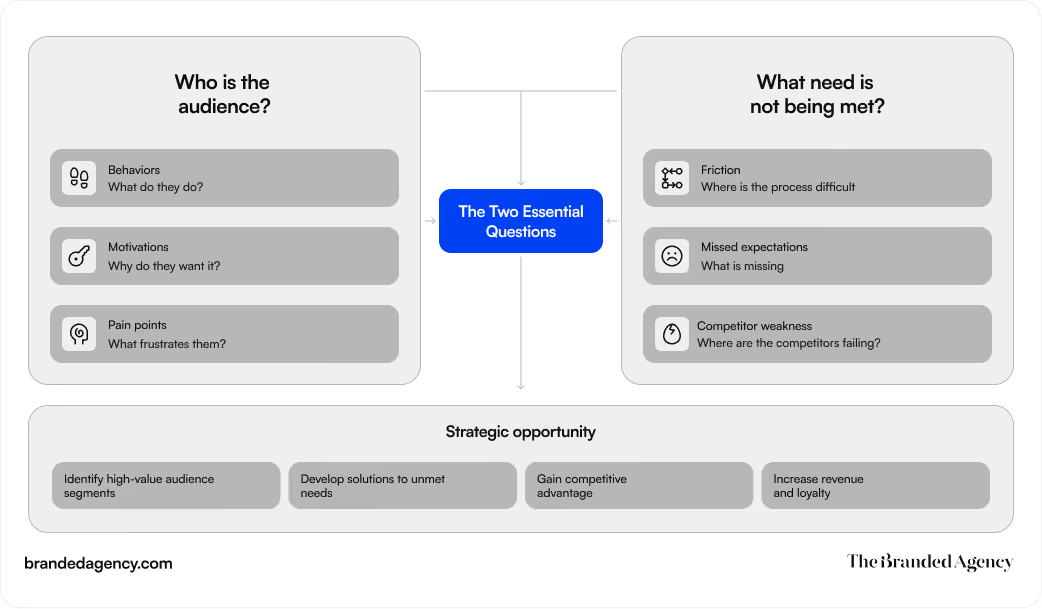
Two Questions to Ask About Your Target Audience
- Who is most likely to choose your brand, and what are they trying to accomplish?
- What do they use today, and where does that option fall short?
Start with a recent customer. Ask what prompted them to look, which alternatives they considered, and what nearly stopped them from buying. Then compare their answers with what you hear in sales calls, reviews, and support emails. The phrases that come up repeatedly can tell you which benefit to lead with, which claim needs proof, and which customer question your homepage should answer first.
How to Identify Your Brand’s Competitors
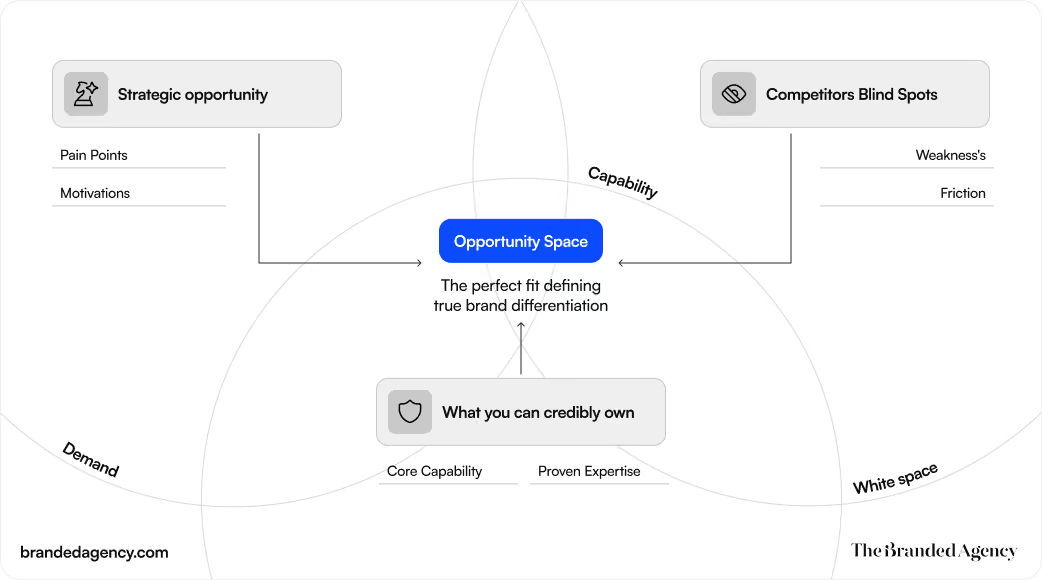
Start with the alternatives your customers actually consider. One of the most useful questions you can ask a recent buyer is: “What would you have done if you hadn’t chosen us?” Their answer may point to a competitor you already track or a different way of solving the same problem.
Take a premium home coffee machine. A direct competitor might be another machine at a similar price. But a buyer might also be weighing whether to keep their current brewer or stick with their morning café stop. Each alternative gives you a different question to answer. Against another machine, a shopper may care about ease of cleaning. Against the café, they may care more about getting a coffee they enjoy before they leave the house.
Choose three alternatives that come up in customer conversations. For each, write down:
- Why customers choose it. Look at the price, the promise, and what buyers praise in reviews.
- Where customers compromise. Look for recurring frustrations and check whether they matter to your audience.
- What you can prove. Identify one advantage you can demonstrate through a product feature, a customer result, or the way you deliver your service.
Use those findings to write your brand positioning statement. If a competitor could put the same statement on its homepage without changing a word, get more specific about who you serve and why they choose you.
The Three Parts of a Brand Strategy
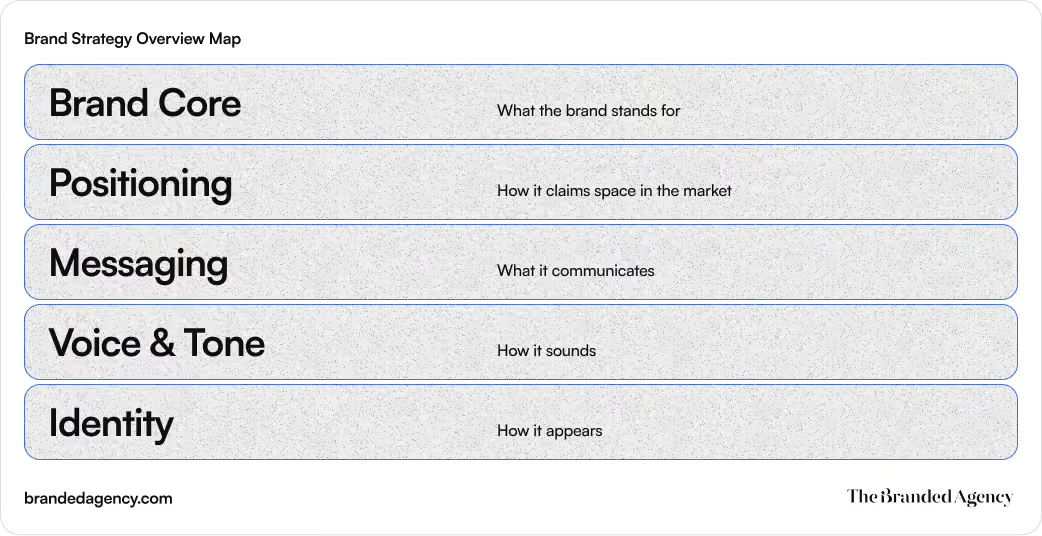
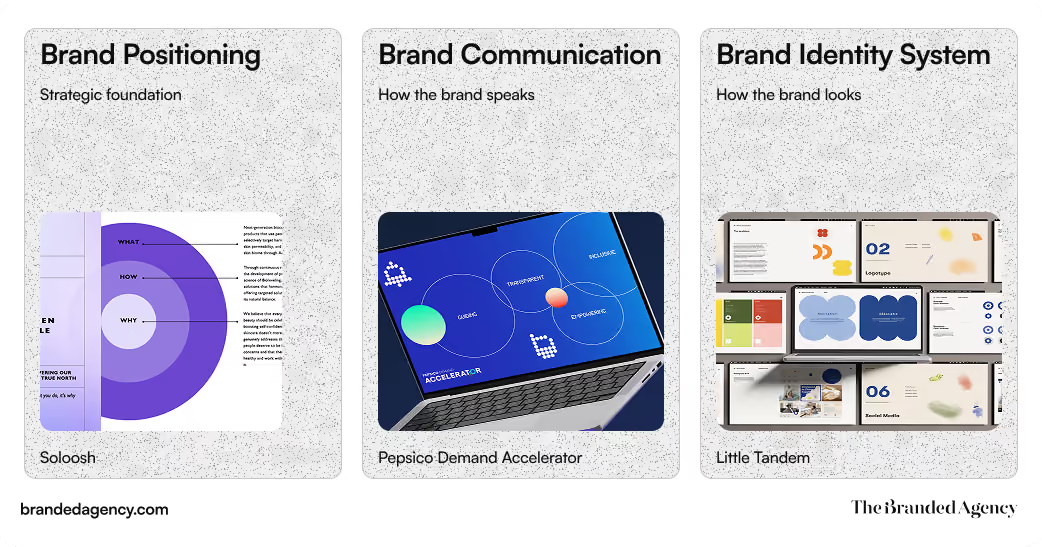
At The Branded Agency, we use the six steps above to shape three connected parts of a brand: its positioning, its communication, and its visual identity.
- Brand positioning strategy. Positioning defines who you serve, why those customers should choose you, and what makes that promise credible. Your values and vision help guide those choices. Your brand positioning statement captures them in a form your team can use.
- Brand communication strategy. Your communication strategy turns that positioning into language. It establishes the messages you want customers to remember, the evidence behind each one, and the brand voice your team uses across your website, sales conversations, and customer support.
- Brand identity system. Your visual identity makes the brand recognizable. It includes your logo, colours, typography, imagery, and graphic elements, along with guidance on how to use them together. Those choices should reflect your positioning and work wherever customers encounter you, from a product label to a mobile screen.
Your homepage is a simple way to see how the three parts work together. Positioning determines which benefit leads. Communication shapes the headline. Visual identity guides the photography, type, and layout that help customers notice and understand it.
1. Brand Positioning: Why Should Customers Choose You?
Start with a question your sales team hears in one form or another: “Why should I choose you when I could choose something else?” Your brand positioning gives everyone on your team a clear, credible answer. It identifies the customer you’re best equipped to serve, the alternatives they consider, and the difference you can deliver.
Your purpose, vision, mission, and values help you decide which promises your business can stand behind. Give each one a distinct job:
- Purpose: What customer problem made this business worth starting?
- Vision: If you solve that problem well, what changes for the people you serve?
- Mission: What do you do, for whom, to bring that future closer? A useful brand mission statement describes work your team would recognize on an ordinary Tuesday.
- Core values: Which principles guide a difficult decision? If you value simplicity, for example, would you leave out a popular feature because it makes the product harder for your core customer to use?
Now bring those answers back to the buying decision. Try completing this sentence: “For customers who ___, we offer ___, which matters because ___. They can see that difference in ___.” That last blank is a useful test. If the only proof you can offer is “great quality” or “excellent service,” look for a detail a customer could actually verify. These brand positioning statement examples can help you get more specific.
2. Brand Communication Strategy: What to Say and How to Say It
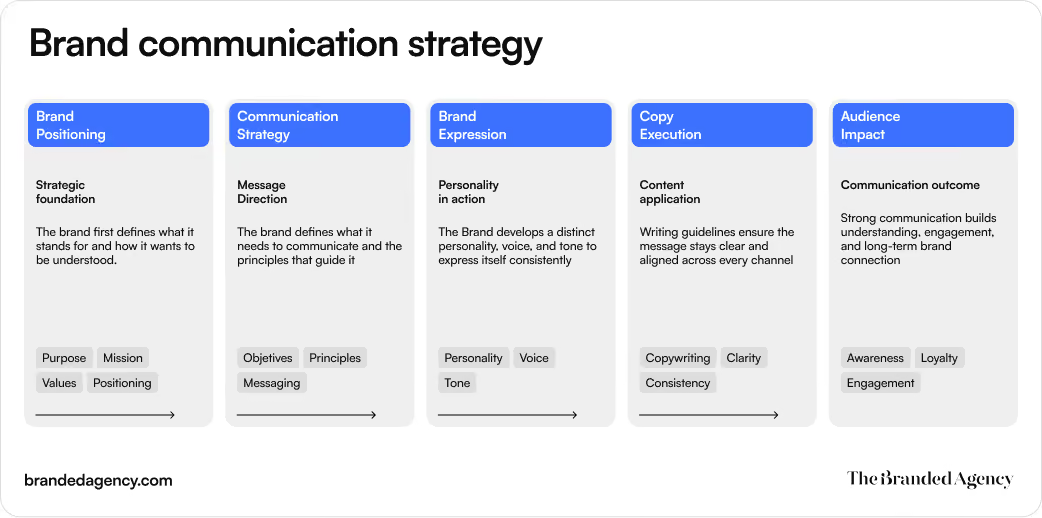
Your communication strategy turns your positioning into language people understand. It helps a copywriter decide which benefit belongs in the homepage headline, gives a salesperson evidence to support that claim, and guides a support rep responding when the experience falls short.
Build your communication guidelines around four decisions:
- Objectives and principles. What should someone understand or feel confident doing after they hear from you? Set a few rules that help your team get there. For a technical product, one might be: Explain what the feature helps someone do before naming the technology.
- Key messages and proof. Decide what customers need to remember and which message comes first. Pair each claim with a demonstration, a product detail, or a customer example. Your brand pillars can help you choose the themes worth repeating.
- Personality, voice, and tone. Personality describes the qualities you want people to recognize. Your brand voice expresses those qualities in words, while your tone adjusts to the situation. A friendly brand might sound playful in a launch email and calm when helping someone with a delayed order.
- Copywriting guidelines. Give writers examples they can use. Document preferred product names, words customers actually use, and a few before-and-after edits. If your voice is “straightforward,” show what that sounds like: “Make an espresso at home” gives a writer clearer direction than “Elevate your daily coffee ritual.”
Brand Communication Objectives
A brand communication objective defines what you want a particular audience to understand, believe, or do. Start with the question standing between your customer and their next decision.
For a premium coffee machine brand, that question might be, “Could I actually make a good espresso with this before work?” A useful objective would be to help first-time buyers understand how the machine fits into their morning. That gives your team something specific to create: a short demonstration showing the whole process, including cleanup. To see whether it helped, ask prospective buyers what still feels unclear and track how often the same question comes up in sales conversations.
Brand Communication Principles
Communication principles are the editorial rules your team follows across your website, advertising, sales, and customer support. A useful principle helps two people make a similar decision when writing independently. For example:
- Lead with the customer’s question. If shoppers want to know how much counter space a machine takes up, give them the dimensions and a photo of it in a real kitchen.
- Show the evidence behind the claim. If you describe cleanup as simple, show which parts need rinsing and how to remove them.
- Use the words customers use. Read reviews and support emails before naming a feature or writing a headline. A shopper who asks “How do I clean it?” gives you a perfectly good heading for the product page.
Key Messaging Guidelines
Messaging guidelines establish what to say first, what to say next, and what evidence supports each claim. Start with your brand positioning statement, then translate it into language a customer would use.
For the coffee machine brand, the lead message might be “Make espresso at home before work.” The product page could support that message with a brewing demonstration, followed by answers about setup and cleanup. A sales rep could use the same message and ask, “Walk me through how you make coffee now.” The wording fits the channel, while the underlying promise stays consistent.
Brand Personality
Brand personality is the set of human qualities people associate with your business. To identify yours, look at how your team behaves when a customer needs help. If reviews regularly mention that your staff explain unfamiliar products patiently and make people feel comfortable asking questions, knowledgeable and approachable are traits you can build on.
Choose two or three traits and give each one an observable behaviour. For an approachable coffee brand, that might mean explaining a brewing term the first time it appears and welcoming questions from someone buying their first machine. Our guide to defining your brand personality takes you through that exercise.
Brand Voice
Brand voice is how your personality comes through in writing. It shapes your vocabulary, sentence structure, and the level of expertise you assume your reader has.
An approachable coffee brand might write, “Choose your cup size, then press brew. We’ll walk you through your first espresso.” Short sentences, familiar words, and a clear next step give a writer a pattern they can reuse. Include examples like this in your brand voice guidelines so new team members can hear what your brand sounds like.
Brand Tone
Tone is how you adjust that voice to suit what the customer is experiencing. Consider how the same coffee brand might speak in two situations:
- First delivery: “Your machine is here. Let’s make your first espresso.”
- Delayed delivery: “Your machine is arriving later than we promised. Here’s the latest delivery estimate and how to reach us if it doesn’t arrive.”
Both messages sound straightforward and helpful. The first shares the customer’s excitement. The second acknowledges the inconvenience and answers the question they’re likely asking. Build your brand tone guidelines around situations your team handles regularly, so writers have an example when the wording matters most.
3. Brand Identity System: How Your Brand Is Recognized
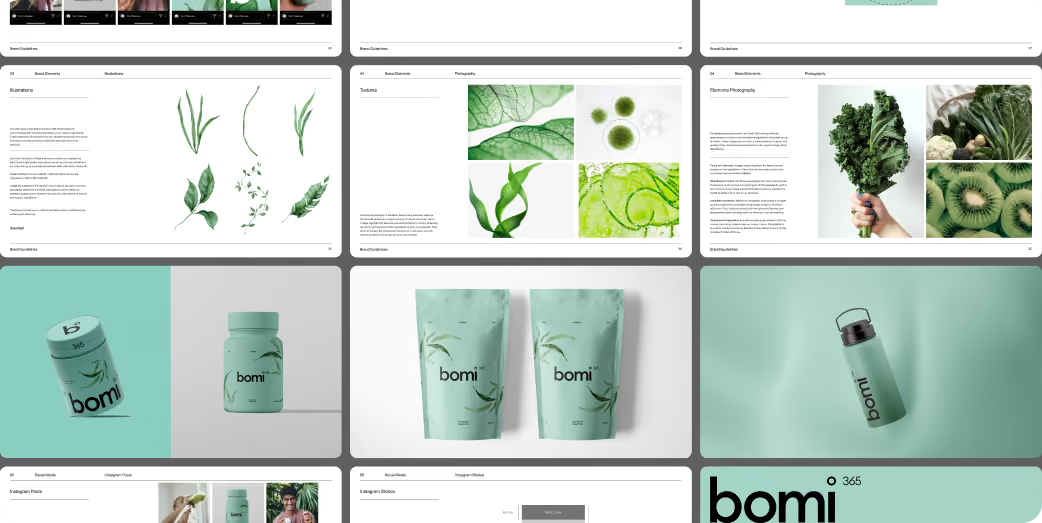
A brand identity system is the set of visual elements and design rules that make your brand recognizable across packaging, your website, advertising, and other places customers encounter it. Your positioning gives those design choices a purpose. If you want customers to see your brand as approachable and easy to use, that should influence everything from the type on the box to the images on the product page.
A practical visual identity system includes:
- Logo and variations. Define how your logo appears on a storefront, on a small product label, or as a profile image. Test it at the smallest size customers will actually see.
- Colour palette. Give each colour a job. Specify which colours identify the brand, which work as backgrounds, and which draw attention to an action. Check that text stays easy to read in each approved combination.
- Typography and layout. Show how headlines, descriptions, prices, and instructions work together. A customer scanning a shelf or browsing on a phone should be able to find the most important detail quickly.
- Photography, illustration, and graphic elements. Define what your imagery should show and how it should feel. Include examples of lighting, composition, icons, or patterns so different designers can produce work that belongs to the same brand.
Consider the premium coffee machine example. If your positioning centres on café-quality espresso at home, a close-up of the finished pour shows shoppers what they’re buying. A wider shot of the machine on a real kitchen counter helps them picture owning it. Both photos can share the same lighting and colour palette while answering different customer questions.
Before approving the identity, apply it to three things your customers will actually see: a product box, a mobile product page, and a getting-started card. Can shoppers recognize the same brand across all three? Can they find the information they need on each one? Use those applications as examples in your brand guidelines, so the next person designing for your brand can see how the system works in practice.
Want to learn more about brand platforms, Brand Strategy and Brand Identity? Keep reading!
How to Use Customer Feedback to Refine Your Brand Strategy

Customer feedback helps you check whether the reasons people choose your brand match the reasons you give them to buy. Start with a recent purchase and ask three questions:
- What were you trying to solve when you started looking?
- What else did you consider, and what nearly stopped you from choosing us?
- Now that you’ve used the product, what would you tell someone else about it?
Compare the answers with product reviews, sales conversations, and support emails. Pay attention to who is speaking and when. A first-time shopper can tell you what’s unclear before they buy. A longtime customer can tell you which part of your promise you consistently deliver. Look for patterns within each group before changing your positioning or messaging.
Take the coffee machine example. If buyers repeatedly say, “I wanted good espresso without learning how to be a barista,” ease of use may deserve more space on the product page. Show a first-time user making a cup. If owners say setup was confusing, revisit the instructions before making a stronger claim about simplicity. The first insight changes how you communicate the promise. The second helps you deliver it.
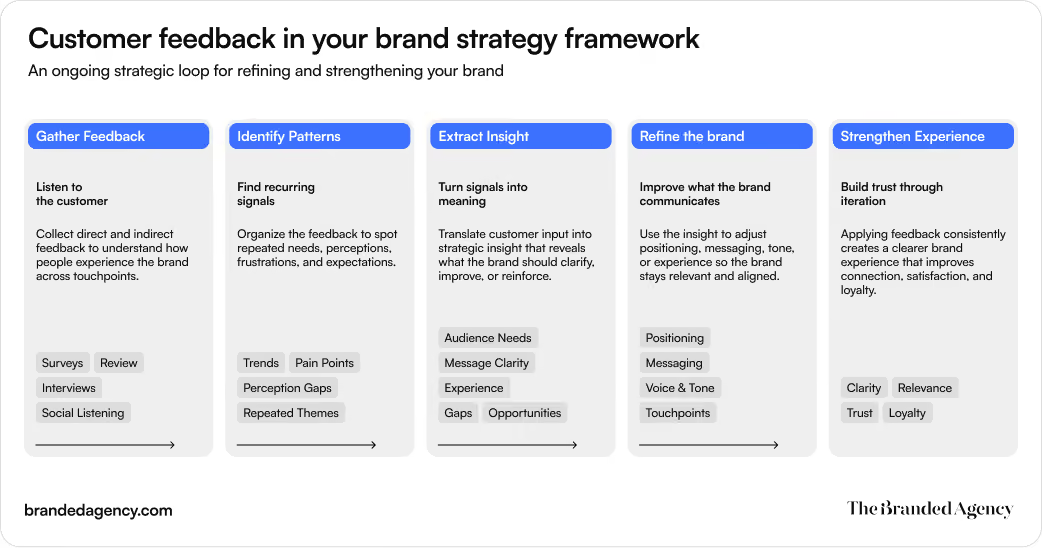
How to Collect Customer Feedback
Choose a feedback method based on what you want to learn. Someone comparing products can tell you what’s missing from your website. Someone who has used your product for six months can tell you whether it delivered on your brand promise.
- Post-purchase surveys. Ask one question after checkout, while the decision is fresh: “What was the deciding factor in choosing us?” Give buyers space to answer in their own words. An unexpected answer can tell you more about your positioning than a list of preset options.
- Website feedback forms. On a product or pricing page, ask: “What information are you still looking for?” Record which page prompted the response so your team knows where to make the improvement.
- Customer interviews. Speak with people who bought, returned a product, or chose a competitor. Start with: “Walk me through your decision, starting with what made you look in the first place.” Ask which alternatives they considered and what ultimately tipped the decision.
- Reviews and support conversations. Look for details customers consistently praise, questions that keep coming up, and gaps between what buyers expected and what they experienced. Keep the exact wording. It can help you describe a benefit in language your audience already uses.
- Social listening. Review comments, mentions, and comparisons to see how people describe your brand unprompted. If a comment gets attention, check whether the same issue comes up in interviews, reviews, or support conversations before acting on it.
How to Turn Customer Feedback Into Decisions
For each useful piece of feedback, record what the customer said, where they were in the buying process, and what decision it could inform. “I couldn’t tell whether this machine would fit under my cabinets” gives your team a more specific problem to solve than “improve the product page.”
Group similar comments and look for the underlying need. Several shoppers asking for a comparison tool may simply need two product measurements displayed side by side. Prioritize issues based on how often they occur and how much they affect the customer. A single report of a checkout failure warrants investigation right away.
Before making a change, decide who will own it and how you’ll check whether it helped.
Examples of Customer Feedback in Action
- When shoppers need more information. If customers ask whether a coffee machine fits under their cabinets, add its dimensions and the clearance needed to refill it beside the product photos. Track size-related questions per 100 orders before and after the update.
- When customers struggle after purchase. If new owners say their first espresso tastes bitter, ask them to walk you through how they made it. If several miss the same step, revise the getting-started card. Then ask a new owner to make a cup using only those instructions and observe where they hesitate.
- When buyers reveal a stronger selling point. If customers consistently say they chose the machine because it looked easy to clean, test a short cleaning demonstration on the product page. Compare add-to-cart rates and ask buyers what influenced their decision.
When a customer flags a problem you fix, tell them what changed. A short message is enough: “You mentioned it was hard to tell how much clearance the machine needs. We’ve added that measurement beside the product photos.”
When to Update Your Brand Strategy
A confusing instruction usually calls for a copy edit. A pattern in why people buy deserves a closer look at your positioning. If your homepage leads with advanced features but customers consistently say they chose you for simplicity, investigate that gap before planning your next campaign.
It’s also worth revisiting your strategy when you enter a new market, introduce a different offer, or find that your sales and marketing teams give different answers to “Why should a customer choose us?”
Once you make a decision, update your brand guidelines with an example your team can use. Then apply it where customers will notice it first, whether that’s a homepage headline, a sales presentation, a product label, or a welcome email.
If your team is working through a change like this, explore our brand strategy and positioning services or talk to The Branded Agency about the decision you’re trying to make.
Frequently Asked Questions (FAQs)


Sloane Avery
Want to learn more about brand platform?